

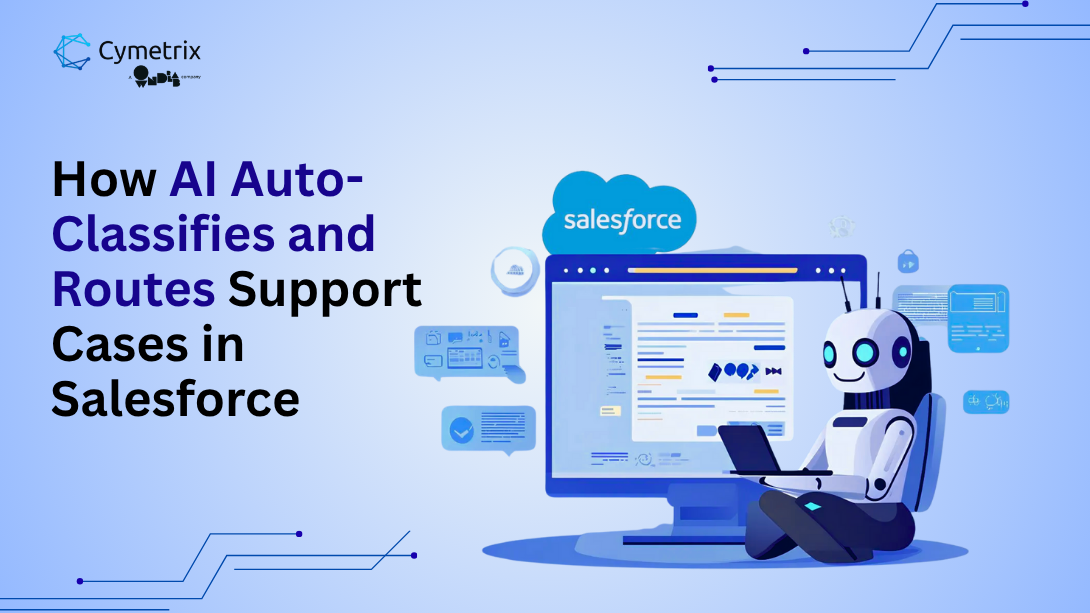
Struggling with delays in Salesforce support? AI case classification and routing in Service Cloud automates processes, reduces errors, and boosts efficiency. Salesforce can go a step further with AgentForce AI agents, taking intelligent actions for faster resolutions.
Introduction
Imagine submitting a support case in Salesforce and, within seconds, it’s categorised, prioritised, and routed to the right agent. No manual sorting, no waiting, just smooth, efficient support. That’s the power of AI-driven case classification and routing in Salesforce.
By blending machine learning with Salesforce Service Cloud, teams get simpler workflows, more productive agents, and faster resolutions. And with AgentForce AI agents, the process is enhanced further by automating actions that would otherwise require human effort.
Let’s explore how this works in practice and why it’s transforming customer support.
The case classification problem in Salesforce
Support cases come in from email, chat, phone, and social channels, each with different levels of urgency and expertise needed. Manually categorising and routing these cases takes time and can lead to mistakes. This often causes delays, frustrated customers, and wasted time for agents.
The old rule-based routing (like “if the subject contains X, send to Y”) can’t keep up with today’s complex service needs. This is where AI helps, enabling Salesforce teams to quickly understand case context and direct it to the right agent.
How AI case classification works
AI case classification in Salesforce Service Cloud uses machine learning algorithms to analyze subject lines, descriptions, and historical resolution data of incoming cases. This feature is often powered by Salesforce Data Cloud. The model learns patterns from past support tickets and predicts the best category for each new case.
Here’s the simplified flow:
- Data Collection - Salesforce gathers data from previous cases, including subjects, keywords, and resolutions.
- Model Training - AI algorithms learn how certain words or phrases connect to specific categories or departments. For example, the model recognises that cases mentioning “refund request” usually belong to Finance, while “error code 404” relates to Technical Support.
- Prediction - When a new case arrives, the system scores it against known patterns.
- Classification - The case is automatically given a label (e.g., billing, technical support, product inquiry).
This reduces manual intervention, minimises misrouting, and allows agents to focus on resolutions instead of categorization.
Routing cases based on AI scoring
Once AI classifies a case, Salesforce applies scoring to determine the most appropriate routing. Rather than relying on static rules, the system evaluates factors such as urgency, complexity, agent skill, and workload distribution to ensure each case reaches the right person at the right time.
For example, in our Salesforce practice, we’ve seen how the AI model can distinguish between a routine “password reset” request and a high-priority “system outage” report. The outage case is instantly routed to a senior technical agent, while the password reset goes to an available support associate. This type of prioritization demonstrates how AI makes routing smarter, faster, and more reliable.
AgentForce AI agents take this further by acting on routed cases, updating records, preparing resolutions, or initiating predefined workflows automatically. This streamlines operations, reduces repetitive work, and delivers faster outcomes.
Beyond classifying and routing, AI can also automate other everyday Service Cloud tasks. Discover 5 key tasks to automate in Salesforce Service Cloud with AI.
Key Salesforce tools and APIs for AI case classification and routing
Salesforce provides a powerful suite of tools and APIs that automate how cases are classified and routed, helping support teams save time and respond faster.
- Einstein Case Classification- Predicts and auto-fills case fields like category, issue type, or priority based on patterns from historical data.
- Einstein Case Routing- Builds on classification by automatically sending cases to the right queue or agent using AI-driven predictions.
- Omni-Channel Routing- Assigns cases in real time by considering agent availability, workload, and skills.
- AgentForce AI Agents -Extend these tools by automating actions such as initiating refunds or updating records.
- APIs for Custom Models - For specialised scenarios, Salesforce supports integration with external machine learning (ML) APIs (e.g., Google Cloud, AWS, Azure). This feature also supports custom code for advanced classification or sentiment analysis, giving teams flexibility beyond out-of-the-box solutions.
Together, these tools give businesses the ability to streamline case handling, reduce misrouting, and improve overall customer support efficiency. To ensure they work seamlessly within your processes, partnering with a Salesforce consulting experts can make configuration and adoption much smoother.
How AgentForce AI agents take support to the next level
From our experience, Salesforce Einstein AI effectively classifies and routes cases within Service Cloud. AgentForce AI agents take this further: they don’t just assign cases, they act on them, pulling customer data, initiating workflows, and even automating routine resolutions.
For example, if a customer reports, “I was charged twice,” Einstein AI would route it to billing, leaving the refund for a human agent. AgentForce AI Agents, however, can identify the issue, pull account details, and even automate the refund process or prepare it for quick agent approval.
This not only speeds up resolutions but also reduces repetitive work and ensures consistent, reliable outcomes. Want to see how it can transform your support team? Talk to our AgentForce consultant.
Real-world impact on support metrics
From our experience, AI case classification and routing in Salesforce, and additionally, AgentForce for advanced automation, deliver measurable improvements:
- Faster Response and Resolution Times – AgentForce AI agents automate case classification, routing, and predefined actions, reducing manual work so cases reach the right queue and get resolved faster.
- Increased First-Contact Resolution (FCR) - When cases are directed to the right expert on the first attempt, issues are often resolved in one interaction. Customers really appreciate this.
- Improved Agent Productivity – Agents spend less time on repetitive tasks thanks to AgentForce automations, focusing instead on complex customer issues.
- Enhanced Customer Satisfaction (CSAT) - By enabling faster responses, accurate case routing, and personalised support, Salesforce with AI and AgentForce ensures customers feel heard and valued. This improvement is clearly reflected in higher CSAT scores, positive feedback, and increased customer loyalty.
Conclusion
AI case classification and routing in Service Cloud, enhanced with AgentForce AI agents, aren’t just about saving time; they reshape the entire support experience. Customers get quicker resolutions, agents work more efficiently, and businesses build stronger relationships through consistent service.
At Cymetrix, we’ve seen how these solutions can truly transform service teams when implemented the right way. Organisations can also collaborate with a Salesforce Service Cloud partner to ensure smooth adoption and tailored AI workflows.
Curious how this could transform your business?
Talk to our expert today to see how Salesforce AI and AgentForce can be tailored to your unique support needs.
FAQs
1. What is AI case classification in Salesforce?
AI case classification is the use of machine learning to automatically analyse support case details like subject lines, descriptions, and past resolutions, and assign them to the right category or department.
2. Can AI assign support cases in Salesforce?
Yes, AI doesn’t just classify cases, it also routes them to the right agent or queue. Tools like Einstein Case Classification, Einstein Case Routing, and Omni-Channel Routing ensure cases reach the right person faster.
3. How accurate is AI-based ticket routing in Salesforce?
Accuracy depends on the quality of your past case data and model training. With strong historical data, AI can significantly reduce misrouting and improve resolution speed compared to rule-based methods.
4. Which Salesforce tools are used for AI case classification and routing?
Key tools include Einstein Case Classification, Einstein Case Routing, and Omni-Channel Routing. You can also integrate external AI models (like Google Cloud or AWS) for advanced classification or sentiment analysis.
5. How does AgentForce classify and route cases differently from Einstein AI?
Einstein AI focuses on classifying and routing cases, while AgentForce takes it further by automating actions like processing refunds or pulling account details for faster, consistent resolutions.
6. How does AI case classification improve customer support metrics?
AI reduces manual errors, speeds up response times, and ensures cases are handled by the right agent the first time. This boosts productivity, first-contact resolution, and customer satisfaction.