

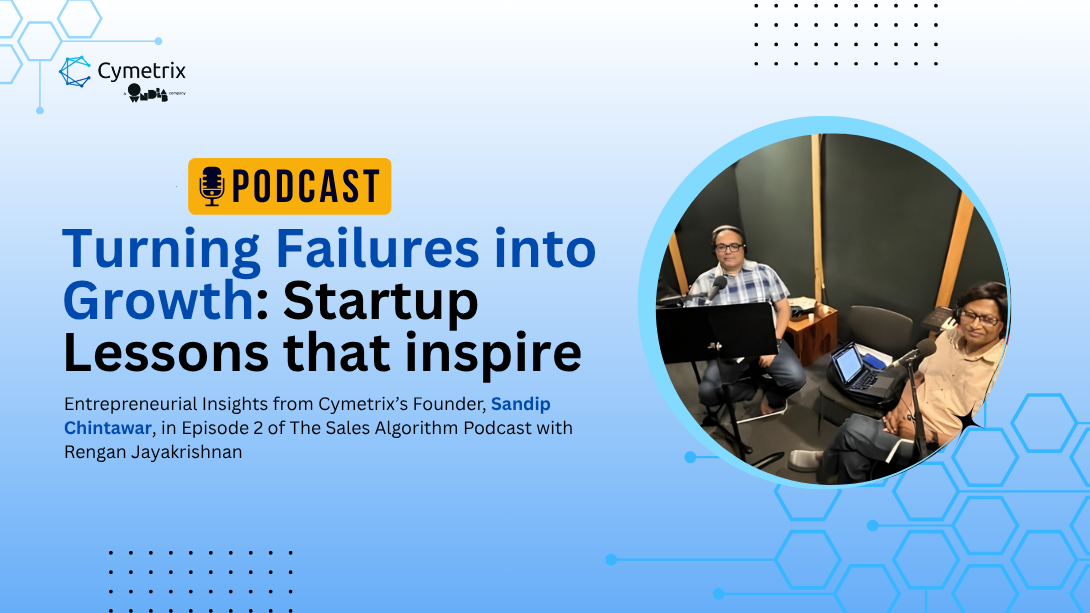
In Episode 2 of The Sales Algorithm Podcast, interviewer Rengan Jayakrishnan once again sits down with Cymetrix Founder Sandip Chintawar to explore how failures, pivots, and perseverance shaped his entrepreneurial journey and growth mindset.
Introduction
Every founder’s journey is a mix of ambition, risk, and resilience. In the first episode of The Sales Algorithm, host Rengan Jayakrishnan (RJ) sat down with Sandip Chintawar, Founder of Cymetrix, to discuss his early entrepreneurial path from IIT Bombay to building one of Silicon Valley’s earliest analytics startups and leading Cymetrix, a trusted Salesforce partner in India. If you missed it, you can catch up on Episode 1 insights here.
For the second episode, RJ reconnects with Sandip to dive deeper into a critical theme: the role of failures, setbacks, and pivots in building a startup. From leaving a stable job in India to starting a company in the US with no prior sales experience, Sandip shares candid insights on perseverance, partnerships, and the importance of aligning with your strengths.
This episode offers valuable lessons for founders, aspiring entrepreneurs, and anyone navigating uncertainty in the startup world.
You can listen to the full episode here: https://open.spotify.com/episode/3uCpaSnZxRp4uR2W6pWuya?si=sWx1VFTfS_yu5bdA6huLlg
Key Insights from the Conversation
Here are some of the most impactful moments from Sandip’s discussion with RJ:
Q (RJ): Did your entrepreneurial journey begin during your Master's at the University of Roorkee (now IIT Roorkee)?
A (Sandip): Not really. In the 1990s, India was still a socialist, permit-based economy. Opportunities were limited; getting basic amenities like a telephone or gas connection took years. The IT industry was small, mostly focused on low-end staffing in the US. I had a well-paid job in Delhi after graduation, but it wasn’t fulfilling because it provided no chance to develop deeper interdisciplinary computer science skills.
Q: You left a very good job in Delhi. What was your mindset at that time, and what were you seeking?
A: Leaving that job surprised many, but I wanted more than just a paycheck. I spent seven to eight months meeting entrepreneurs and industry experts in Mumbai/Pune. Learning was my focus. I wasn’t interested in going to the US through a staffing firm or for mere education, I wanted real skills, which eventually led me to a research engineer position at IIT Bombay with full access to labs and libraries.
Q: How did the idea of entrepreneurship crystallize in your mind?
A: At IIT Bombay, I realized that to work on my interest in networking and chip design, I either had to go abroad or develop my own software product. A professor encouraged me to go to the US, and once there in 1993, I decided to develop my own product, analyzing “can I sell?” and “where do I stand?” which became the foundation of my entrepreneurial journey.
Q: You launched your first company within 18 months of being in the US, despite a small network and no prior sales experience. How did you manage this?
A: I was intensely driven at the time:
- Product Idea & Co-Founder: Reconnected with an ex-colleague; chose case tracking software.
- Limited Research Tools: The mid-90s lacked internet B2B research; everything relied on human connection.
- Networking & Learning: Met 3–4 people weekly; leveraged alumni connections.
- Personal Development: Took accent reduction, English, and public speaking courses to build relationships.
- Gaining Information: Spent evenings in libraries learning technology, business, and immigration law.
- Product Development: Coded after day jobs at Donutville coffee shop. The drive to learn initially exceeded the goal of building the company.
Q: Tell us about the failure of the initial case tracking product and the pivot to your second product.
A: The first product was technically sound but didn’t gain traction due to a limited network. We pivoted to web analytics in India, focusing heavily on market research rather than just coding.
Q: What was the technological challenge in developing the web analytics product?
A: Many challenges:
- No Standards: Web 1.0 browsers changed every quarter; we had to support all.
- New Technology Stack: Used Java 1.1, built basic widgets ourselves; highly unstable.
- Limited Resources: Self-funded through consulting; hired young IIT Bombay programmers without senior guidance.
Q: You mentioned constant technological changes. What analogy can you draw for today’s founders?
A: It’s similar to developing AI products today. Models change weekly, requiring founders to stay current. Just as we struggled with browser updates, today’s founders face rapidly evolving AI landscapes. Time and energy management are key.
Q: You faced many failures and challenges. How did you manage to persevere?
A: I never referred to them as failures. They were part of the journey. The key was to make the work enjoyable.
“If you have fun while working and do what you like, it is not work.”
We made sacrifices for long-term goals, but passion drew people in. Many challenges did not pan out, but as I always say, fail fast to succeed fast. Every setback offered a chance to change direction and get better.
Q: What is your most critical piece of advice for aspiring entrepreneurs?
A: Self-awareness is key. Play to your strengths and find people who complement your weaknesses. Don’t chase external validation; it leads to shortcuts and corruption. Follow your true interests and stay honest. Entrepreneurship is not about money; it’s about people and relationships.
Q: What role do luck and societal context play?
A: Luck matters a lot. Where you start, California or a small town, shapes your early path. But the next 30 to 40 years are yours. Keep trying and take advantage of opportunities.
Q: What message do you have for India’s view on business and failure?
A: We need a mindset shift. Making money isn’t bad, and you don’t have to compromise integrity to do business. Communities that support failure (like in Gujarat) build stronger ecosystems. India needs more of this support to encourage risk-taking.
Conclusion
Sandip Chintawar’s journey reminds us that every setback is a stepping stone. From failed products to global partnerships, his story is proof that resilience, honesty, and passion are core to entrepreneurial success.
At Cymetrix, we carry forward this philosophy, helping businesses scale with Salesforce and AI-driven solutions, while building trust and long-term relationships. If you’re considering innovations like Salesforce Agentforce, working with an experienced Agentforce consultant can provide the right guidance to align technology with your business goals.
Talk to our expert today to explore how we can help your business navigate challenges and unlock growth.