

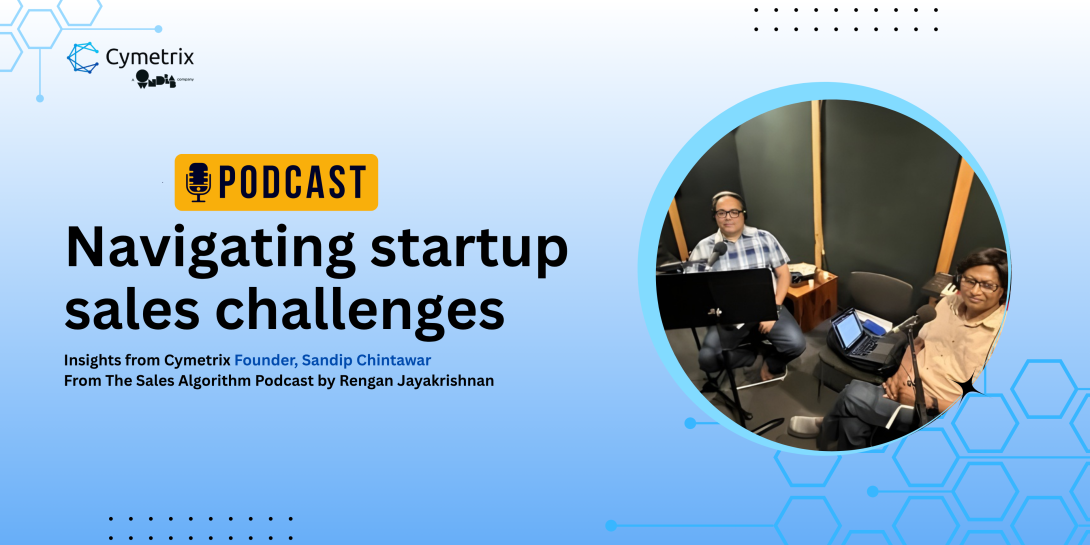
In this podcast, Cymetrix Founder Sandip Chintawar sits down with interviewer Rengan Jayakrishnan, a global sales strategist, to talk about startup sales, building trust, and how founders can grow and scale their businesses successfully.
Introduction
Building and scaling a startup is never a straight path. It’s full of challenges, lessons, and chances to grow. To explore these ideas, Rengan Jayakrishnan (RJ), a mentor and sales strategist with over 30 years of experience in global markets, launched a new podcast series called The Sales Algorithm, available on Spotify, focused on sales challenges across different stages of a startup lifecycle.
For the very first episode, RJ invited Sandip Chintawar, Founder of Cymetrix, a trusted Salesforce Partner in India, to share his experiences as a serial entrepreneur who has built, scaled, and exited multiple ventures across Silicon Valley and India. Sandip’s journey from IIT Bombay to leading Cymetrix today is packed with valuable insights for founders navigating the world of B2B sales and startup growth.
You can listen to the full episode here: https://open.spotify.com/episode/5mGsMotMK4r9goiRevXshH?si=49A5Bu5ESVWaKjPPVZHvJw
Let’s dive into some of the most insightful takeaways from their conversation:
Q (RJ): Sandip, can you start by sharing your journey of moving to the US in 1993 and launching your first company?
A (Sandip): Sure. After my stint at IIT Bombay, I moved to Silicon Valley when the internet was just emerging, around 8,000 - 10,000 websites existed then. I saw the opportunity and built a website analytics software to help companies understand their traffic. The company grew, got acquired, and that marked the beginning of my entrepreneurial journey.
Q: What do you think is the most crucial element in B2B sales?
A: Trust. Business is human-to-human, not just product-to-customer. In my first startup, honesty about what our product could and couldn’t do built credibility. That trust helped us win early customers, many of whom grew into industry leaders over time.
Q: You mentioned integrity as a foundation. How did it impact your sales approach?
A: Customers have choices. They evaluate not just the product but also the founder’s credibility. If they see consistency, honesty, and long-term commitment, they’re willing to invest in the relationship, and that trust lasts far beyond one product or company.
Q: Many entrepreneurs obsess over outcomes. How should they view their journey?
A: It’s a journey, not a one-time event. Many founders believe their first startup defines their entire path. In truth, you need to appreciate the process. Failures, rejections, and successes all contribute to your growth. Even the best founders face setbacks. What counts is getting back up and using what you learned.
Q: What role does networking play for founders?
A: Networking is critical. Many technologists are introverts and struggle with communication. If that’s the case, find a co-founder who can sell, build relationships, and communicate your vision. Together, it makes a strong team.
Q: How important is having a well-defined sales strategy?
A: Extremely important. Startups often focus only on building solutions but ignore product positioning and target markets. Knowing your customer persona and creating a sales strategy aligned to it is what drives adoption and growth.
Q: At the conceptualization stage, should founders engage with customers before building a product?
A: Absolutely. Don’t wait for the product. Share your idea with potential customers, get early adopters, and refine your MVP based on their feedback. Execution speed matters more than worrying about competition copying your idea.
Q: How should early-stage founders think about pricing?
A: Pricing is about ROI for the customer. Ask early adopters how much value your product creates for them. Then, validate whether it forms a viable business model for you. It’s about open communication and creating a win-win situation.
Q: What about direct sales vs partnerships in the early stages?
A: Always start with direct sales. As a founder, you must interact with customers directly to learn their psychology and usage patterns. Once you have clarity, then expand via channel partners or technology partnerships. Personally, I’m a big fan of technology partnerships; they give you scale by aligning with bigger players in the ecosystem.
Q: Finally, what’s your advice on sales approach, top-down or bottom-up?
A: Both. Top-down gives you executive buy-in but takes time; bottom-up is easier, but decision-making can stall. A blended approach works best to convince senior executives while also engaging end-users. That combination accelerates adoption.
Conclusion
From building one of the earliest analytics startups in Silicon Valley to leading Cymetrix today, Sandip Chintawar’s journey offers invaluable lessons for founders. Trust and credibility matter. Failures are stepping stones. Execution speed drives success.
At Cymetrix, we bring this same philosophy to life. We help businesses scale with smart Salesforce and AI-driven solutions. We prioritise trust, reliability, and long-term partnerships. If you’re considering innovations like Salesforce Agentforce, working with experienced Agentforce consultants can provide the right guidance to align technology with your business goals.
Want to accelerate your sales growth and enhance your customer experience? Talk to our experts today and explore tailored solutions for your business.