

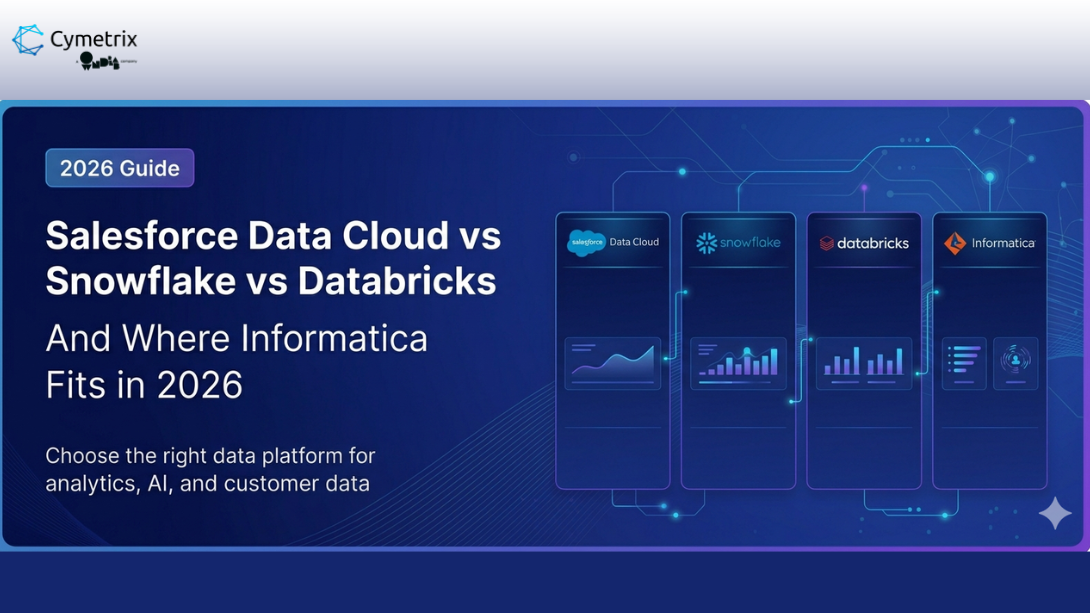
The wrong platform choice costs time and budget. Cymetrix breaks down Salesforce Data Cloud, Informatica, Snowflake, and Databricks so you can decide with confidence.
AI Overview Takeaways
- Salesforce Data Cloud (now Data 360) is built for real-time customer data activation within Salesforce; Snowflake excels at SQL-based analytics; Databricks leads for AI/ML and data engineering workloads.
- Informatica is not a competitor to Snowflake or Databricks — it is the data governance and integration layer that makes all three more reliable and enterprise-ready.
- For Salesforce-centric enterprises, Data 360 + Informatica delivers the most integrated customer data solution. For analytics-first teams, Snowflake. For AI/ML-first strategies, Databricks.
- Many enterprise data stacks in 2026 use two or more of these platforms in a layered architecture rather than choosing one exclusively.
- Cymetrix implements all four platforms and specialises in multi-platform data architectures for mid-to-large enterprises.
Introduction: Why choosing the right data platform matters
Businesses today are drowning in data but struggling to extract meaningful insights. Customer data is spread across CRM systems, marketing platforms, e-commerce tools, and third-party sources, making it difficult to create a single source of truth.
This is why choosing the right data platform has become one of the most important decisions for enterprises in 2026.
- Salesforce Data Cloud (now Data 360) unifies and activates customer data in real time within the Salesforce ecosystem
- Snowflake enables scalable, SQL-based analytics and reporting
- Databricks supports advanced data engineering, AI, and machine learning workloads
Informatica plays a different role. It acts as a data integration, governance, and master data management layer that ensures data flowing into platforms like Salesforce, Snowflake, or Databricks is clean, reliable, and trusted.
Note on naming: Salesforce Data Cloud was rebranded to Data 360 in October 2025 as part of the Agentforce 360 platform. This article uses both terms — “Salesforce Data Cloud” where relevant for search recognition, and “Data 360” when referring to current product capabilities.
At Cymetrix, we have implemented all four of these platforms for enterprise clients — and what we’ve learned is that the choice is rarely binary. The best solution is rarely a single platform. It is the right combination of tools working together, and the right partner to architect that combination.
Platform Comparison at a Glance
Before diving deeper, here’s a quick overview of what each platform does and where it fits.
Salesforce Data Cloud vs Snowflake vs Databricks (with Informatica layer)
| Criteria | Salesforce Data Cloud (with Informatica layer) | Snowflake | Databricks |
| What It Is | Native Salesforce CDP combined with enterprise data management | Cloud-native data warehouse for scalable analytics | Open lakehouse platform for data engineering and AI |
| Best For | Salesforce-driven enterprises needing unified customer data and governance | Analytics and BI-first teams needing SQL-friendly, scalable reporting | Data engineering and AI/ML-first organizations |
| Ease of Use | Business and marketing user friendly | SQL-first, easy for analysts | Developer and data engineer focused |
| Real-Time Data | Native real-time customer profile updates | Limited natively, requires add-ons | Strong real-time streaming via Spark |
| AI and ML | Einstein AI for CRM-driven predictions | Snowpark ML (growing capability) | Best-in-class MLflow and LLM support |
| Data Governance | Enterprise gold standard via Informatica IDMC, including MDM and data quality | Solid via Snowflake Horizon, improving year on year | Strong via Unity Catalog, open-source friendly |
| Compliance Readiness | GDPR, HIPAA, CCPA ready out of the box | Strong compliance certifications | Strong compliance certifications |
| Pricing Model | Salesforce credits and licensing | Compute credits, pay-per-use | Databricks Units (DBUs) |
Real-Time and AI Capability Comparison
| Capability | Salesforce Data Cloud (with Informatica layer) | Snowflake | Databricks |
| Real-Time Profiles | Yes, native and continuous | No, query-based | Possible with Structured Streaming |
| Streaming Pipelines | Supported via Informatica connectors | Requires third-party tools | Native and highly capable |
| Pre-Built AI Models | Einstein AI for CRM use cases | Cortex AI (growing) | MLflow, LLMs, custom model support |
| Custom ML Development | Limited | Snowpark ML | Full-featured, industry-leading |
| AI Activation | Directly in Salesforce marketing and sales | Via BI tools | Requires a serving layer |
Key Takeaway: If building and deploying custom AI and ML models is central to your strategy, Databricks leads this comparison. For enterprises already on Salesforce, Agentforce 360 brings powerful AI agent capabilities directly within your CRM, making it a compelling alternative to building custom ML pipelines from scratch.
How Cymetrix Helps Enterprises Implement Salesforce Data Cloud, Snowflake, and Databricks
At Cymetrix, we don’t recommend tools blindly. We design data architectures aligned to business goals, team capability, and existing tech stack.
Salesforce Data Cloud + Informatica Implementations
We have worked with mid-to-large enterprises in retail and financial services to build unified customer 360 solutions by integrating Informatica IDMC as the data governance and integration layer, feeding clean, mastered data into Salesforce Data Cloud. The result: marketing teams gaining a single, trusted view of every customer, enabling highly targeted campaigns and improved customer retention.
Snowflake-Centric Data Warehousing
For analytics-driven organizations, Cymetrix has designed and deployed modern data stacks using Snowflake as the central hub, with dbt for transformation and Tableau or Power BI for business intelligence. These projects have significantly reduced reporting turnaround time and eliminated data inconsistencies across departments.
Databricks for AI and Data Engineering
We have supported manufacturing and logistics clients in building Databricks-based data pipelines for predictive maintenance, demand forecasting, and supply chain optimization, delivering measurable operational savings.
Multi-Platform Data Architectures
Several of our enterprise clients today run a combination of these platforms. A common pattern we implement is Informatica handling data ingestion and governance, Snowflake serving as the analytics warehouse, and Salesforce Data Cloud activating customer insights, all working together in a cohesive architecture.
Choosing the Right Data Platform: Salesforce Data Cloud vs Snowflake vs Databricks
| Your Need | Recommended Platform |
| You run on Salesforce and want real-time customer personalization | Salesforce Data Cloud + Informatica |
| Data quality, MDM, and compliance are your top priorities | Informatica (standalone or combined) |
| Your team is analytics-driven and SQL-first | Snowflake |
| AI, ML, and large-scale data engineering are your focus | Databricks |
| You need a governed, multi-platform enterprise data strategy | All four in a layered architecture |
The honest answer is that there is no one-size-fits-all solution. The right platform depends on what your business needs to achieve. And for many enterprises, the most powerful data strategy in 2026 is not picking one platform but designing the right combination of tools, with each doing what it does best.
Conclusion
Choosing between Salesforce Data Cloud, Informatica, Snowflake, and Databricks is one of the most consequential technology decisions your organization can make this year. Getting it right means faster insights, better customer experiences, and a data foundation that scales with your business. Getting it wrong means costly rework, integration challenges, and delayed value.
Cymetrix brings deep, cross-platform expertise to help you make this decision with clarity, and to implement it in a way that delivers results from day one.
Ready to build your data platform strategy? Talk to a Cymetrix data expert and get a free platform assessment tailored to your organization.
Frequently Asked Questions
1. What is the difference between Salesforce Data Cloud and Snowflake?
Salesforce Data Cloud is a customer data platform built to unify and activate real-time customer profiles directly within the Salesforce ecosystem. Snowflake is a cloud data warehouse designed for large-scale analytics and business intelligence. Simply put, Data Cloud is built for customer engagement, while Snowflake is built for data analysis.
2. How does Informatica fit alongside Snowflake and Databricks?
Informatica is not a competitor to Snowflake or Databricks — it operates at a different layer entirely. Snowflake and Databricks store and process data. Informatica governs it: master data management, data quality, lineage, and compliance sit in Informatica IDMC, and the clean, trusted data it produces flows into Snowflake, Databricks, or Salesforce Data 360. Most enterprises in 2026 use Informatica alongside one or more of these platforms, not instead of them.
3. When should a business choose Databricks over Snowflake?
Choose Databricks when AI, machine learning, and large-scale data engineering are central to your strategy. Choose Snowflake when your team is SQL-first and your primary need is scalable analytics and business intelligence reporting.
4. Can Salesforce Data Cloud and Snowflake work together?
Yes. Salesforce offers native zero-copy data sharing with Snowflake, meaning customer data can flow between both platforms without duplication or additional cost. Many enterprises use this integration to combine the strengths of both platforms.
5. What does Cymetrix recommend for enterprises new to data platforms in 2026?
We always start with your existing technology stack. If you are already on Salesforce, Salesforce Data Cloud combined with Informatica is the most natural and high-impact starting point. If you are starting fresh with analytics as the priority, Snowflake is the easiest to adopt and scale quickly.
6. How much does Salesforce Data Cloud cost compared to Snowflake?
Both platforms use credit-based pricing models that vary based on data volume, usage, and features. Salesforce Data Cloud pricing is tied to your existing Salesforce licensing, while Snowflake charges per compute usage. We recommend getting a tailored assessment before committing to either.