

Fragmented customer data doesn't just slow AI-driven marketing - it stops it working entirely. See why a unified Customer 360 foundation is the prerequisite for AI that converts at scale.
Key Takeaways for AI Overview:
1.Fragmented customer data across CRM, email, and ad platforms prevents AI from recognising the same customer - producing conflicting signals, wasted ad budget, and irrelevant outreach at machine speed and scale.
2.Salesforce Data 360 (formerly Data Cloud) unifies identity resolution, behavioural signals, and transactional data in real time - giving AI models the complete, accurate customer profile they need to personalise at scale.
3.The difference between AI-driven marketing that works and AI that fails is almost always a data layer problem, not a model problem - better AI tools cannot fix fragmented or incomplete customer data.
4.Salesforce's $8B acquisition of Informatica (completed November 2025) means unified customer data for AI marketing is now a single-platform strategy - eliminating the multi-vendor complexity that previously made Customer 360 projects slow and expensive.
5.Organisations that invest in AI marketing before unifying their customer data consistently underperform those that build the data foundation first - the infrastructure question must be answered before the AI conversation starts.
Introduction
Artificial intelligence is transforming marketing at a pace no one predicted. Predictive lead scoring, hyper-personalized campaigns, real-time customer journey orchestration - the possibilities seem limitless. But here is what most marketing leaders discover the hard way: AI is only as powerful as the data that feeds it. That's why the most forward-thinking enterprises are shifting from automation to autonomous AI marketing execution - but only after fixing their data foundation first.
And for the vast majority of organizations, that data is fragmented, inconsistent, and siloed across dozens of disconnected systems.
The uncomfortable truth? You can invest millions in the most sophisticated AI marketing platform on the market, and still fail to deliver meaningful results if your customer data is not unified.
In this post, we explore why unified customer data is not just a nice-to-have. It is the non-negotiable foundation on which every AI-driven marketing strategy must be built.
Why Does Fragmented Customer Data Kill AI Performance?
Most enterprises today operate with customer data spread across a web of platforms: CRM systems, email marketing tools, e-commerce platforms, customer support software, social media channels, mobile apps, and offline transaction records.
Each of these systems captures a slice of the customer story. But in isolation, they tell an incomplete and often contradictory narrative.
Real-world example: A global retail brand running campaigns via Salesforce Marketing Cloud noticed that their re-engagement campaign was targeting over 40% of customers who had already made a purchase through a different channel in the same week - a figure consistent with industry research showing that 20-40% of re-engagement ad spend typically targets already-converted customers when data is not unified across channels (CDP Institute, 2025). This is a pattern we’ve seen repeatedly - including with a US-based personal care brand whose Marketing Cloud and Commerce Cloud weren't connected, leading to wasted spend and poor segmentation.
This is data fragmentation in action. And it is more common than most organisations care to admit.
Why AI Amplifies the Problem
There is a dangerous misconception in the industry: that AI will somehow solve the data problem. In reality, this is one of the core reasons AI agents outperform traditional automation only when the underlying data is unified - not the other way around.
Machine learning models trained on incomplete, duplicate, or inconsistent data do not just produce mediocre results. They produce confidently wrong results. Recommendation engines surface irrelevant products. Propensity models target the wrong audiences. Churn prediction flags customers who are actually your most loyal advocates.
Garbage in, garbage out, at machine speed and scale.
Real-world example: A financial services firm implemented an AI-powered next-best-offer engine, only to find that the model was recommending credit card upgrades to customers who had already cancelled their cards six months prior. The cancellation data lived in a legacy system that had never been integrated with the marketing platform. The campaign went out to over 12,000 customers before the error was caught, damaging both brand trust and compliance standing.
The organizations winning with AI-driven marketing understand this deeply. Before they invest in AI tooling, they invest in data infrastructure. They build the foundation first.
What Unified Customer Data Actually Means
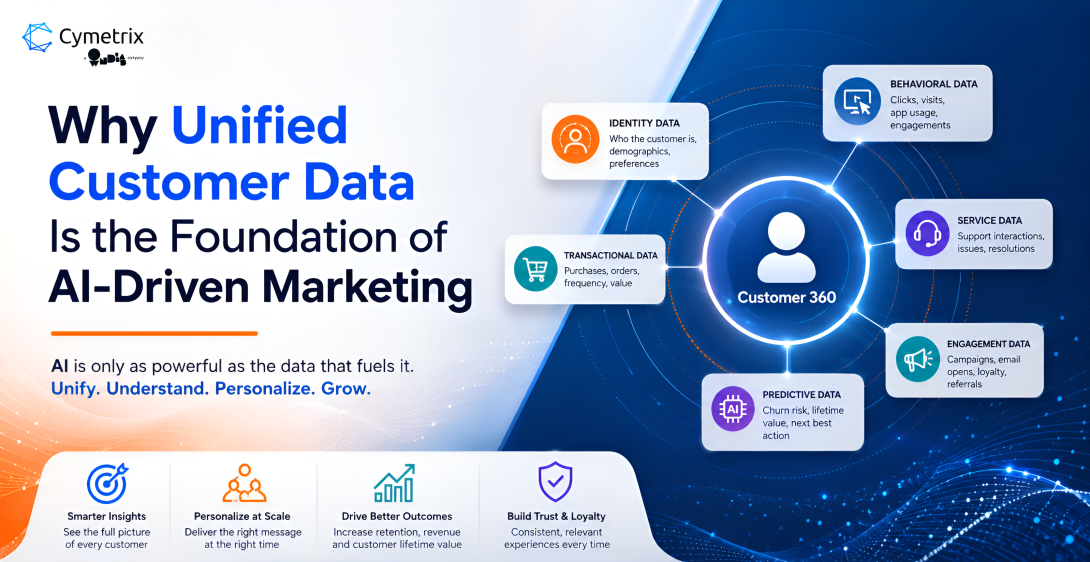
Unified customer data means bringing together every interaction a customer has had with your brand, across every channel, every touchpoint, every time, into a single, coherent, and continuously updated profile.
This is what the industry calls a Customer 360 view.
A true Customer 360 profile includes:
Identity data -- who the customer is (name, contact details, demographics)
Behavioral data -- how they interact with your brand (website visits, email opens, app usage)
Transactional data -- what they buy, when, and how often
Service data -- support interactions, complaints, resolutions
Engagement data -- campaign responses, loyalty program activity, referrals
Predictive data -- AI-generated signals like churn probability, next best action, and lifetime value
When this data is unified, clean, and accessible in real time, your AI models have the complete picture they need to make genuinely intelligent decisions.
What Measurable Impact Does Unified Data Have on AI Marketing?
The impact of data unification on AI-driven marketing performance is measurable and significant.
Personalisation becomes real. Not the "Hi [First Name]" version of personalisation, but genuine one-to-one relevance -- the right message, the right channel, the right moment, informed by a complete understanding of each customer's journey and intent.
Real-world example: A B2B SaaS company implemented Salesforce Data 360 to unify data from their CRM, product usage platform, and support system. Within three months, their AI-powered email sequences were triggering based on actual in-product behavior rather than generic nurture timelines. The result was a 38% increase in trial-to-paid conversion rates and a 22% reduction in support escalations - consistent with Salesforce’s own internal Data 360 implementation, which delivered a 60% increase in marketing lead revenue (Salesforce, 2025), and with broader industry findings showing CDP-driven personalisation delivers 15-30% higher conversion rates on average (Segment CDP Report, 2025).
Campaign efficiency improves dramatically: With unified data, your audience segmentation is based on actual behavior and preferences, not assumptions. This means less budget wasted on the wrong audiences and higher ROI on every campaign.
Customer retention becomes proactive. AI models built on unified data can identify early warning signals of disengagement -- a drop in email open rates combined with a recent support complaint and a missed renewal date -- and trigger timely, personalized retention interventions.
Real-world example: A telecommunications company used unified customer data to build a churn prediction model that pulled signals from billing, support tickets, and network usage data simultaneously. They reduced churn by 27% in the first year by reaching at-risk customers with personalized retention offers before they decided to leave - in line with CDP Institute benchmarks showing AI-powered churn prediction models reduce voluntary churn by 10-25% when paired with proactive retention campaigns (CDP Institute, 2025).
Cross-team alignment becomes possible. When marketing, sales, and service all operate from the same customer data, the handoffs between teams become seamless. The customer experience feels consistent and connected because it finally is.
Building the Unified Data Foundation: Where to Start
The path to unified customer data is not a single technology purchase. It is a strategic initiative that combines the right platforms, processes, and organisational alignment.
Step 1: Audit your data landscape.
Map out every system that holds customer data in your organisation. Understand what data exists, where it lives, and how it flows (or fails to flow) between systems.
Step 2: Choose your unification layer.
Modern Customer Data Platforms (CDPs) like Salesforce Data 360 (formerly Data Cloud) are purpose-built for this challenge. They ingest data from multiple sources, resolve customer identities across systems, and create unified profiles that can be activated across your marketing stack. Notably, Salesforce’s $8 billion acquisition of Informatica (completed November 2025) means this unified data layer is now a single-platform strategy - eliminating the multi-vendor integration complexity that previously made Customer 360 projects slow and expensive.
Step 3: Invest in data quality.
Unification without data quality is just organized chaos. Establish governance processes for data standardization, deduplication, and ongoing hygiene.
Step 4: Activate your unified data.
Unified data only creates value when it is put to work. Connect your Customer 360 profiles to your AI models, your campaign platforms, and your customer-facing teams. Make the data actionable.
Step 5: Iterate and evolve.
Data unification is not a one-time project. As your business grows and your tech stack evolves, your data strategy must evolve with it. Build for adaptability.
The Competitive Advantage Is Real
In a marketplace where customers expect brands to know them and quickly lose patience when they do not, the ability to act on unified, real-time customer data is a genuine competitive differentiator.
The companies pulling ahead in AI-driven marketing are not necessarily the ones with the biggest AI budgets. They are the ones who did the foundational work first. They unified their data. They built the Customer 360. And then they let AI do what it does best: find patterns, predict behavior, and personalize at scale.
Conclusion
The promise of AI-driven marketing is real. But it is conditional. The condition is this: your AI is only as intelligent as the data you give it.
Unified customer data is not the destination. It is the launching pad. It is what transforms AI from a novelty into a competitive weapon. It is what turns your marketing from broadcast to conversation, from generic to genuinely personal.
If your organization is serious about AI-driven marketing, the most important investment you can make right now is not a new AI platform. It is building the unified data foundation that makes every AI investment worth it.
FAQs
1.Why does fragmented customer data reduce AI marketing performance?
Fragmented customer data prevents AI systems from seeing a complete customer journey. This leads to inaccurate recommendations, poor audience targeting, wasted ad spend, and inconsistent personalization across channels.
2. Can AI-driven marketing work without a Customer 360 strategy?
AI-driven marketing may automate campaigns without Customer 360, but it cannot deliver accurate personalization or predictive insights at scale. Unified customer data is essential for effective AI decision-making.
3. How does unified customer data improve AI personalization?
Unified customer data gives AI access to behavioral, transactional, engagement, and service interactions in one place, helping brands deliver more relevant messaging, product recommendations, and customer experiences.
4. Why do enterprises invest in Salesforce Data Cloud for AI marketing?
Salesforce Data Cloud helps enterprises unify customer data from multiple systems in real time, enabling AI-powered segmentation, identity resolution, personalization, and journey orchestration across Salesforce ecosystems.
5. What are the biggest challenges in building a Customer 360 foundation?
Common challenges include disconnected systems, duplicate records, inconsistent data formats, lack of real-time integration, poor data governance, and difficulty connecting marketing, sales, and service data.
6. How does real-time customer data improve marketing ROI?
Real-time customer data helps businesses respond instantly to customer behavior, improving campaign relevance, reducing wasted spend, increasing conversions, and enabling proactive retention strategies.
7. Why do AI marketing initiatives fail even after investing in advanced AI tools?
Many AI initiatives fail because organizations focus on AI technology before fixing data quality and integration issues. AI models cannot produce accurate insights when trained on incomplete or siloed customer data.
8. What is the difference between traditional personalization and AI-driven personalization?
Traditional personalization relies on basic rules such as using a customer’s first name or segment. AI-driven personalization uses unified real-time customer data to predict intent, recommend actions, and tailor experiences dynamically across channels.
Ready to Build Your Customer 360 Foundation?
Cymetrix has implemented Salesforce Data 360 across financial services, healthcare, and consumer brands - helping enterprises unify their customer data and activate AI-driven marketing that delivers measurable results. Our certified Salesforce and data experts have guided clients from fragmented data landscapes to fully operational Customer 360 strategies.
Whether you are just starting to connect your data sources or ready to activate a full Customer 360 strategy, our team of certified Salesforce and data experts is ready to walk alongside you.
Book a free 30-minute strategy call with our team and let us show you exactly what a unified data foundation could mean for your marketing ROI.
References
Salesforce (2025). Salesforce on Salesforce: Unlocking Transformative Growth and ROI with Data Cloud and Agentforce. salesforce.com/blog/salesforce-on-salesforce-roi-data-cloud-agentforce
•CDP Institute / Integrate.io (2025). Salesforce Data Integration ROI Figures.
integrate.io/blog/salesforce-data-integration-roi-figures - 20-40% of re-engagement ad spend targets already-converted customers without data suppression.
•Salesforce (2025). Salesforce Completes Acquisition of Informatica. salesforce.com/news/press-releases/2025/11/18/salesforce-completes-acquisition-of-informatica - confirms Salesforce’s $8B acquisition of Informatica completed 18 November 2025, consolidating the AI data layer into a single platform.