

Most Salesforce organisations have years of CRM data, but that doesn't mean it's AI-ready. Duplicate records, stale fields, and incomplete account data can stall every Agentforce deployment before it begins. Here's what AI-ready actually means and how to get there.
Key Takeaways / AI Overview
- Having years of Salesforce data does not mean having AI-ready data; they are structurally different things.
- Agentforce agents read directly from your CRM records. Duplicate, stale, or incomplete records produce unreliable agent decisions, not obvious errors.
- The three data problems that most commonly break Agentforce before launch are: duplicate account and contact records, stale or unstructured contact data, and incomplete account hierarchies.
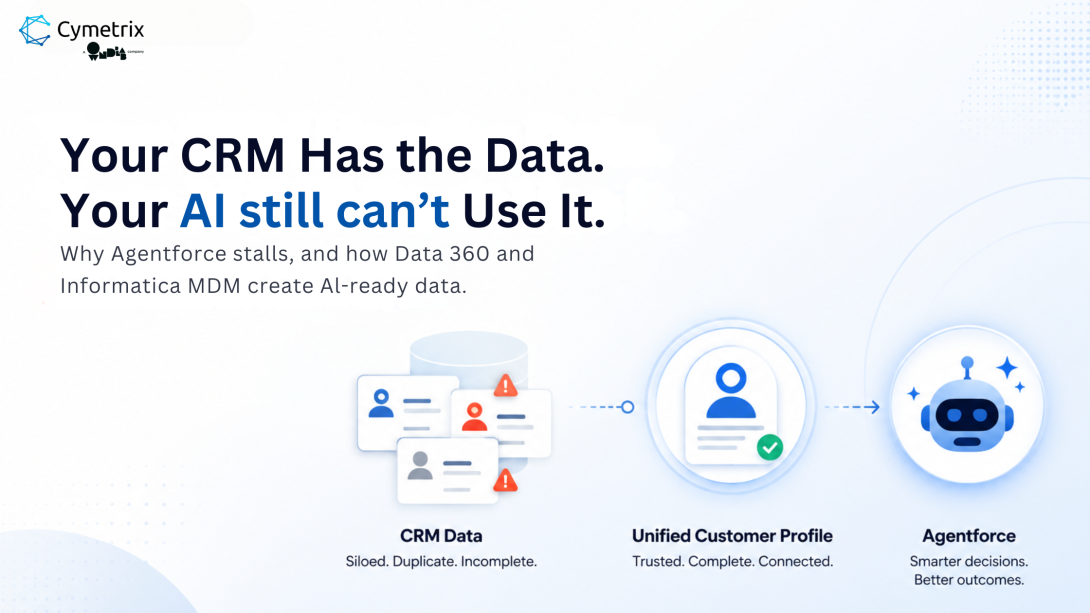
- Salesforce Data 360 (formerly Data Cloud) creates the unified customer profile. Informatica MDM governs the quality of data going into it. Agentforce runs on top.
- Salesforce completed its acquisition of Informatica in November 2025, making MDM a native capability within the Salesforce stack.
- Companies that address the data layer before deploying AI agents consistently reach production faster and see measurably better agent performance.
Introduction
AI doesn't fail because of the algorithm. It fails because of what the algorithm is reading from.
If you have Salesforce and you're planning to deploy Agentforce, or you already tried and hit a wall at the pilot stage, the problem is almost certainly not the AI configuration. It's the data sitting underneath it.
This is something we see consistently across implementations: organisations that have been on Salesforce for five or ten years, with thousands of records, strong adoption, and solid pipeline data, assume they are ready for AI. The data exists. The platform is there. The contract is signed.
What nobody says clearly enough, early enough, is that having Salesforce data and having AI-ready data are two entirely different things. The gap between them is exactly where Agentforce deployments either succeed or stall.
Here is what that gap looks like, why it exists, and what it takes to close it.
The Assumption That Stalls Every AI Project
The most common misconception we hear when a company begins an Agentforce engagement is some version of this: "We've been on Salesforce for eight years. We have all the data."
What they have is raw material. What an AI agent needs is something more specific.
AI agents make decisions, they surface recommendations, qualify leads, route service cases, and generate responses. Every one of those decisions is only as good as the record it reads from. When a human sales rep is working the CRM, they apply judgment. They notice that one of the three "John Smith at Acme" records is outdated. They know that the phone number in the notes field is the right one, not the one in the contact field. They compensate for the gaps without thinking about it.
An AI agent cannot do that. It takes the record at face value, at scale, without hesitation.
So when a live Salesforce organisation has duplicate accounts, stale contact data, empty industry fields, and free-text where structured data should be, the agent does not fail visibly. It makes plausible-sounding decisions from bad inputs. That is harder to catch than an obvious failure, and significantly more damaging when it reaches a customer.
The first thing an Agentforce deployment tends to reveal is every data quality problem the organisation has been ignoring. The AI does not create those problems; it simply makes them impossible to overlook.
What "AI-Ready" Actually Means in a Salesforce Environment
"Clean data" is not specific enough to be actionable. When we assess an organisation's Salesforce data ahead of an Agentforce deployment, we check for four specific properties. Working with a Salesforce Data Cloud consultant who understands Agentforce prerequisites means these questions come up before a single workflow is configured, not after.
Unified records: One authoritative version of each customer, consolidated across every cloud and external touchpoint, not a contact in Sales Cloud, the same person under a slightly different email in your marketing platform, and a variant in your service system with different field values. Salesforce Data 360 (formerly Data Cloud, rebranded at Dreamforce in October 2025) exists to create and maintain this unified profile. Without it, your agent is drawing from fragments of the same customer across multiple systems and treating them as separate entities.
No duplicates: Industry estimates put duplicate record rates in live enterprise CRM orgs at 10 to 30 percent of total records. Every duplicate is a decision the agent can get wrong, recommending to a churned account, routing a case to the wrong contact, or surfacing outdated purchase history. Master data management (MDM) is the governance discipline that eliminates duplicates at the source, not just in a one-time cleanse. Informatica MDM, now part of the Salesforce platform following Salesforce's $8 billion acquisition of Informatica in November 2025, brings this capability natively into the stack.
Complete field coverage: Agentforce agents use field values to segment, score, and route. If your Industry field is empty on 40 percent of accounts, your industry-based routing logic works on 60 percent of your data. That is not a workflow configuration problem. It cannot be fixed in the agent builder. It can only be fixed in the data itself, through a field completion initiative before the agent goes live.
Current data: A contact record last updated two years ago may be technically valid. An AI agent using it to personalise outreach will reach someone who has since left the company, changed their role, or moved well outside the target profile. Staleness is a distinct problem from duplication. It requires ongoing governance, not a one-time cleanse, and a data model that surfaces last-modified dates as a usable signal.
The Three Data Problems That Break Agentforce Before It Starts
Across the Agentforce readiness assessments we run at Cymetrix, the same three data problems appear consistently. They are not exotic edge cases. They are the standard state of a Salesforce organisation that has grown organically over several years.
1. Duplicate account and contact records
This is the most common problem and the most directly damaging to agent performance. The agent cannot distinguish between three versions of the same contact. It either works from the most recently modified one (which may not be the correct one), attempts to reconcile conflicting values at inference time (which it was not designed to do), or produces a response based on a record that was supposed to be merged two years ago.
In practice, this shows up as wrong routing, incorrect ownership assignments, and recommendations served to the wrong contact. In a pilot, it produces the kind of inconsistent results that make stakeholders lose confidence in the AI before the deployment has really begun.
2. Stale or unstructured contact data
Activity data that has not been touched in months. Free-text fields are used where structured picklist values should exist. Phone numbers were entered in the Notes field because the actual Phone field was already populated with a number that no one updated. This data exists, it is not missing, but it is in a form the AI agent cannot use reliably.
An agent trying to personalise a service interaction from a contact record last updated in 2022 is not working from bad data in the traditional sense. It is working from data that was accurate at some point, and no one built the governance process to keep it current. Nine times out of ten, when a service agent returns a nonsensical or irrelevant response during testing, this is the reason.
3. Incomplete account hierarchies and missing relationship data
Enterprise accounts have subsidiaries, parent companies, buying group structures, and shared service contracts. In most Salesforce orgs, these relationships are either not mapped at all or mapped inconsistently by different sales reps using different conventions. An AI agent working on cross-sell, renewal, or upsell logic is working blind if account hierarchies are incomplete. It treats a subsidiary as an independent account with no purchase history, no contract context, and no risk signal, and recommends accordingly.
This is the hardest of the three problems to fix quickly, because it requires both data enrichment and a governance decision about how account relationships should be structured going forward.
How Data 360 and Informatica MDM Fix This
These are two distinct tools that address different layers of the same problem.
Salesforce Data 360 (formerly Data Cloud, rebranded at Dreamforce in October 2025) is the real-time customer data platform that unifies records from across Salesforce clouds and external sources into a single customer profile. It is the foundation layer Agentforce reads from. Without it, agents work from siloed, unsynchronised data across separate clouds.
Informatica MDM is the governance layer that controls the quality of what flows into Data 360, deduplication, record matching, field completion, and data stewardship. Since Salesforce's $8 billion acquisition of Informatica in November 2025, this is a native Salesforce capability, not a third-party integration. Informatica governs the records; Data 360 unifies them; Agentforce consumes them.
Our Salesforce Informatica MDM practice at Cymetrix covers both layers: MDM governance architecture first, and Data 360 unification built on top of it. Most Salesforce partners operate on one side of this stack. Reliable AI deployment requires both in sequence.
What Happens When You Fix the Data First
The pattern is consistent across implementations we have run: organisations that address the data layer before deploying AI agents hit fewer post-launch failures and reach production faster. Agent decision accuracy improves because it is reading from unified, deduplicated, current records. Routing logic works. Personalisation reflects actual customer history rather than a fragment of it.
From our experience, service agents that were routing cases incorrectly in testing have reached over 90 percent accuracy in production after an MDM and Data 360 pass, without any change to the agent configuration itself. The AI did not improve. The foundation under it did.
Experienced Salesforce implementation partners will assess data readiness before scoping an Agentforce project, because data gaps determine the project timeline more reliably than anything else. If that conversation has not come up with your current partner, it is worth raising before the scope is finalised.
Conclusion
If your Agentforce pilot has stalled, or if you're preparing for an AI deployment and have concerns about data readiness, those concerns are often justified.
The challenge is rarely the AI itself. More often, it stems from the data foundation beneath it. Duplicate records, incomplete customer profiles, outdated information, and disconnected data relationships are common realities in Salesforce environments that have evolved over time without a strong MDM strategy.
Salesforce Data 360 and Informatica MDM, now part of the Salesforce ecosystem, provide the capabilities needed to create a trusted, unified data foundation. However, success depends on more than technology alone. Effective governance, the right implementation approach, and a well-defined architecture are what ultimately determine whether Agentforce can deliver meaningful business outcomes.
Before investing further in AI, it is worth understanding whether your data is truly ready to support it.
Ready to assess your Salesforce data readiness? Connect with our team to identify gaps, strengthen your data foundation, and set your Agentforce initiative up for success.
FAQ
1. Why can't AI agents use CRM data directly?
AI agents can read CRM data directly; that is exactly what Agentforce does. The issue is that "reading" the data and "using it reliably" are different things. Duplicate records, stale contact fields, and incomplete account structures mean the agent reads data that is technically present but factually unreliable. Unlike a human user who applies judgment when browsing the CRM, an AI agent takes records at face value. Garbage in, garbage out, just at agent speed and scale.
2. What does AI-ready data mean in Salesforce?
AI-ready data in a Salesforce environment has four properties: it is unified (one authoritative record per customer across all clouds and systems), it has no duplicates, it has complete field coverage for the use cases the agent will handle, and it is current. Meeting all four criteria typically requires both Salesforce Data 360 for unification and Informatica MDM for ongoing governance. Meeting one or two of them is not enough for reliable agent performance.
3. How do you prepare Salesforce data for Agentforce?
The practical sequence is: assess current data quality (duplicate rate, field completion, staleness), implement MDM governance using Informatica to deduplicate and govern master records, build the unified customer profile in Salesforce Data 360, and then configure Agentforce on top of that foundation. Attempting to deploy Agentforce before this foundation is in place is possible, but the agent will run, the performance will be inconsistent, and the post-launch diagnostic burden will be high.
4. What is Informatica MDM for Salesforce?
Informatica MDM is a master data management software that governs data quality, handles deduplication, and maintains consistent master records across systems. Salesforce acquired Informatica in November 2025 for approximately $8 billion, making it a native part of the Salesforce platform. In the context of AI deployments, Informatica MDM governs the quality of data entering Salesforce Data 360 before it reaches Agentforce agents.
5. What is the role of Salesforce Data 360?
Salesforce Data 360 (formerly Salesforce Data Cloud, rebranded at Dreamforce October 2025) is a real-time customer data platform. It unifies customer data from across Salesforce clouds and external systems into a single, AI-ready customer profile. It is the layer directly below Agentforce in the AI stack, the unified data foundation that agents read from when making decisions.
6. How long does it take to make Salesforce data AI-ready?
It depends on current data quality and org complexity. A focused data quality assessment and MDM governance project for a mid-market organisation typically takes 6 to 10 weeks. A full Data 360 unification built on top of that adds another 8 to 12 weeks. For organisations deploying Agentforce on a tighter timeline, a prioritised data sprint scoped to the specific agent use case is the fastest path to a reliable pilot rather than trying to address everything at once.
7. Can we fix the data while Agentforce is already running?
Technically, yes, practically, it creates significant complications. Data problems discovered after an agent is live, when it is producing visible errors in front of customers or internal users, are significantly more disruptive to fix than problems addressed in a pre-deployment data sprint. The diagnostic work of tracing an agent error back to its underlying data adds time and cost that a pre-deployment assessment would have avoided. The better sequence is always: data sprint first, then agent deployment.