
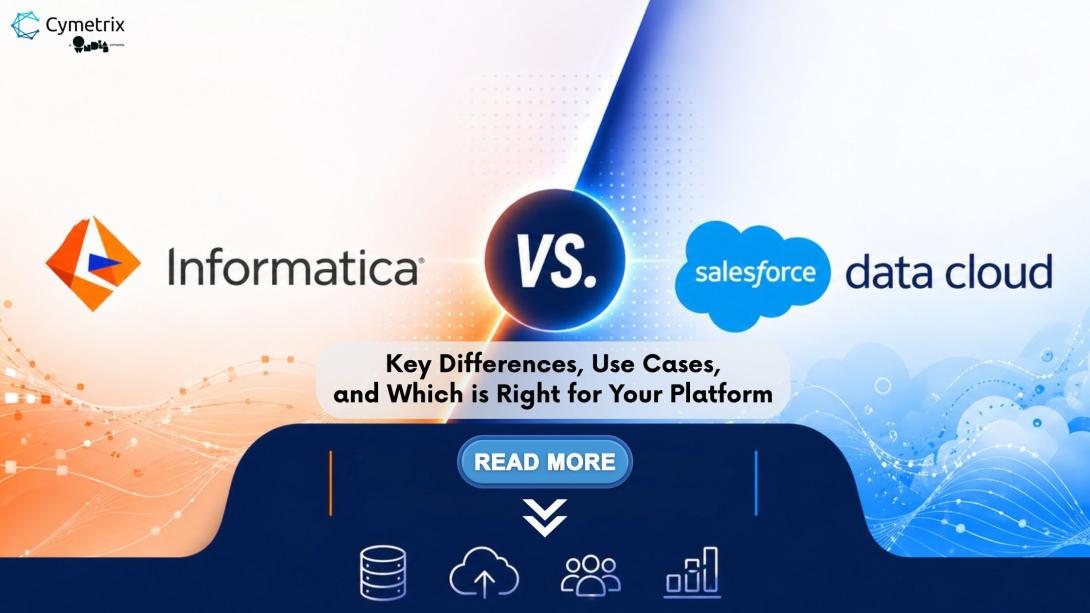
Informatica and Salesforce Data Cloud solve different problems at different layers. This guide breaks down exactly what each does, when you need both, and how they compare to alternatives.
Key Takeaways
• Informatica and Salesforce Data Cloud are not competitors. They operate at different layers of the data stack and are increasingly designed to work together, especially following the November 2025 Salesforce acquisition of Informatica.
• Informatica solves enterprise-wide data quality, MDM, and governance problems across all business systems. Salesforce Data Cloud, now officially rebranded as Data 360 (October 2025), activates unified customer profiles in real time within the Salesforce ecosystem.
• Most large enterprises need both: Informatica as the clean data foundation, Data Cloud as the customer activation layer. Choosing one over the other is usually a false choice.
• If your primary challenge is bad, fragmented, or inconsistent data across systems, start with Informatica. If your challenge is siloed customer data preventing personalization, start with Data Cloud.
• The Salesforce acquisition of Informatica (completed November 2025, USD 8 billion) means these platforms are converging under a single vendor, making the combined Data 360 + Informatica stack Salesforce's answer to enterprise-grade AI-ready data.
Introduction: Two Platforms, One Common Misconception
If you are a business leader trying to make sense of your data strategy, you have likely heard both names: Informatica and Salesforce Data Cloud. They both deal with data. They are both powerful. And they are both expensive to implement incorrectly.
The most common mistake organizations make is treating them as competitors, as if choosing one means you do not need the other. That misconception can cost you significantly, both in wasted spend and in missed opportunity.
This guide breaks down exactly when you need each platform, what they excel at, how they work together, how they compare to non-Salesforce alternatives, and what the 2025 Salesforce acquisition of Informatica means for your decision today.
What Is Informatica, and What Problem Does It Solve?
Informatica is an enterprise data management platform, and it is the operational backbone of your data. It moves, cleans, governs, and connects data across your entire organization, regardless of where it lives or which teams own it.
It is built around its Intelligent Data Management Cloud (IDMC), which handles:
- Data Integration: Pulling data from dozens or hundreds of systems including ERPs, CRMs, cloud apps, and databases, and making them work together coherently.
- Data Quality: Identifying duplicates, errors, and inconsistencies before they cause problems in reports, campaigns, or business decisions.
- Master Data Management (MDM): Maintaining one authoritative golden record for critical entities like customers, products, employees, and suppliers. When your CRM says "John Smith," your ERP says "J. Smith," and your marketing platform has only an email, Informatica resolves all three into one trusted record.
- Data Governance: Enforcing policies around data access, retention, and regulatory compliance (GDPR, HIPAA, CCPA).
- Cloud Data Management: Supporting migrations, modernization, and multi-cloud or hybrid environments.
Best for: Enterprises with complex, multi-system data environments where data quality, governance, integration, and compliance are strategic priorities.
What Is Salesforce Data Cloud, and What Problem Does It Solve?
Data 360 is still widely recognised as a leading Customer Data Platform, but that framing no longer tells the full story. Salesforce has deliberately repositioned it as the enterprise data foundation for Agentforce — the layer that gives AI agents the context they need to act accurately and in real time. Gartner's 2026 Magic Quadrant reflects this shift, describing Data 360 as a "context engine for unifying structured and unstructured data to serve as a foundation for agents and automation." If you are evaluating Data 360 purely as a marketing CDP, you are looking at only part of what the platform now does
Data Cloud connects data from Marketing Cloud, Sales Cloud, Service Cloud, Commerce Cloud, and external sources like web analytics, mobile apps, and third-party platforms. It resolves all of this into a unified customer identity, which is one profile per person, continuously updated as they interact with your brand.
What makes Data Cloud particularly powerful is not just the unification. It is the activation. The unified profile flows directly into the tools your teams already use, giving marketing, sales, and service a live, shared view of every customer.
Best for: Companies already invested in the Salesforce ecosystem who want to break down data silos between customer-facing teams and deliver personalized, real-time customer experiences.
The Core Difference: A Side-by-Side View
They are not competitors. They operate at different layers of your data strategy. One ensures the quality of the raw material; the other puts it to work.
| Informatica | Salesforce Data Cloud (Data 360) | |
|---|---|---|
Primary Focus | Enterprise data management | Customer data unification & activation |
Who Uses It | IT, Data Engineering, Operations, Compliance | Marketing, Sales, CX, Service Teams |
Data Scope | All enterprise data (customers, products, employees, suppliers) | Customer-facing data only |
Lives In | Backend infrastructure, multi-cloud | Natively inside Salesforce |
Key Strength | Data quality, governance, MDM, integration | Real-time personalization, 360 degree customer view |
Output | Clean, governed, integrated data | Activated customer profiles and audiences |
Compliance | Enterprise-grade (GDPR, HIPAA, CCPA, SOX) | Salesforce-level data management |
Works Best With | Any downstream system or platform | Salesforce tools (Marketing, Sales, Service Cloud) |
Real-World Use Cases: Where Each Platform Shines
Marketing
With Informatica
A global consumer brand runs 14 different marketing tools across regions. Customer records in each are slightly different: different email formats, naming conventions, consent flags. Before launching a global campaign, Informatica MDM resolves all records into golden profiles, ensures opt-out flags are correctly synced everywhere, and feeds clean, compliant data to every downstream tool, preventing costly legal and reputational risks.
With Salesforce Data Cloud
The same brand uses Data Cloud to build a real-time segment: customers who purchased in the last 30 days AND opened an email this week AND browsed a product category yesterday. That hyper-specific segment feeds directly into a Marketing Cloud journey that triggers a relevant offer within hours of the browsing behavior, with no batch processing and no overnight delays.
Why You May Need Both
If customer records flowing into Data Cloud are duplicated or have incorrect consent flags, which is an Informatica problem, Data Cloud will personalize and deliver messages to the wrong people, at scale. Clean foundation first, then activation.
Sales
With Informatica
A manufacturing company has account data in their CRM, financial data in their ERP, and contracts in a separate document system. Sales reps waste 20% of their time reconciling discrepancies. One system shows an account as "active," another as "churned." Informatica MDM creates a single golden record per account, synchronized across all systems, so every rep always sees the authoritative view.
With Salesforce Data Cloud
With clean account data in Data Cloud, Sales Cloud automatically surfaces signals: "This account has increased web activity by 40% this month and had three service tickets resolved positively, and they may be ready for upsell." Account executives prioritize outreach based on live behavioral signals, shortening the sales cycle and improving win rates.
Why You May Need Both
Clean master data from Informatica ensures the account records are trustworthy. Data Cloud enriches those records with real-time signals that make them actionable for the sales team.
This pattern of clean master data from Informatica feeding live behavioral signals in Data Cloud is one of the most common architectures Cymetrix implements for enterprise clients in Informatica Salesforce integration engagements. The two platforms are rarely deployed in isolation in complex B2B environments.
Customer Service
With Informatica
A healthcare provider has patient records spread across a billing system, an EMR platform, and a scheduling tool. When a patient calls, the service agent sees three conflicting records. Informatica MDM creates a single patient golden record that feeds all systems, and data governance ensures HIPAA compliance, controlling who can access what and how data can be used.
With Salesforce Data Cloud
The same provider uses Data Cloud to give service agents a real-time view of the patient: their last appointment, open billing question, medication history, and preferred communication channel. Before the patient finishes explaining why they are calling, the agent already has full context. First-call resolution rates improve. Escalations decrease. Patient satisfaction increases.
Why You May Need Both
In regulated industries like healthcare, Informatica handles the governance layer that Data Cloud alone cannot provide. Together, they create a complete, compliant, real-time service experience.
How Do They Compare to Non-Salesforce Alternatives?
This is a question many organizations fail to ask, especially those not fully committed to the Salesforce ecosystem. Here is a consolidated view of where each platform stands against its closest competitors.
| Alternative | Best For | vs. Data Cloud / Informatica |
Segment (Twilio) | Digital-native, engineering-led companies; developer-friendly CDP | More flexible for non-Salesforce stacks; Data Cloud wins on Salesforce activation depth |
Adobe Experience Plat. | Adobe ecosystem users; enterprise B2C marketing | Closest enterprise competitor; choose based on primary ecosystem (Adobe vs. Salesforce) |
Talend (Qlik) | Mid-market; open-source-friendly integration and quality | Informatica more mature for enterprise MDM and AI-powered governance at scale |
Microsoft Purview + ADF | Azure-native environments; existing Microsoft stack | Good for Azure shops; Informatica is stronger for multi-domain MDM and AI data quality |
SAP CDP | SAP-centric enterprises | Natural fit for SAP shops; Data Cloud fits Salesforce shops |
Salesforce Data Cloud vs. Alternatives: Key Insights
Segment (Twilio) is the most popular CDP for digital-native and engineering-led companies. It offers more developer flexibility but lacks the deep Salesforce activation depth that Data Cloud delivers. If you are a Salesforce shop, Data Cloud wins. If you are not, Segment may be faster to deploy.
Adobe Experience Platform is the closest enterprise-grade competitor to Data Cloud. Both unify real-time customer profiles. The choice typically follows your ecosystem: organizations running Adobe Analytics, Target, and Journey Optimizer lean toward AEP; Salesforce organizations lean toward Data Cloud.
What the Salesforce Acquisition of Informatica Changes (and What It Does Not)
Salesforce completed its acquisition of Informatica on November 18, 2025, in a deal valued at approximately USD 8 billion. This is not a minor footnote. It is the single most important context for any organization evaluating either platform in 2026.
What Changes
Informatica is no longer a third-party tool that integrates with Salesforce. It is now a Salesforce product. Salesforce is explicitly positioning the combined offering of Data 360 (formerly Salesforce Data Cloud) plus Informatica as the unified data backbone for Agentforce, its AI agent platform. The pitch is simple: AI agents are only as good as the data behind them, and Informatica provides the enterprise-grade quality and governance layer that makes AI on Salesforce trustworthy.
For organizations already running both platforms, this means:
- Native integration between Informatica IDMC and Data 360 will deepen over time, reducing the integration overhead that previously required custom engineering
- Licensing and renewal conversations will shift. You can expect Salesforce sales teams to bundle Informatica capabilities alongside Data Cloud, MuleSoft, and Agentforce
- The combined Data 360 + Informatica stack is becoming Salesforce's answer to enterprise-grade, AI-ready data management
What Has Not Changed Just Yet
Informatica's platform-agnostic roots remain intact for now. It continues to integrate with SAP, Oracle, Microsoft Azure, Google Cloud, AWS, and hundreds of other systems. Salesforce has publicly committed to maintaining multi-cloud support. However, organizations that rely on Informatica to connect non-Salesforce platforms should monitor the roadmap closely, as product investment will increasingly prioritize Salesforce-native integrations over time.
Existing Informatica contracts are being honored through their current terms. But renewal conversations will look different, and the window to negotiate from a position of knowledge is before your next renewal, not during it.
What 2026 Evaluators Should Factor In
The "Informatica vs. Salesforce Data Cloud" framing of this article is itself becoming less relevant post-acquisition. Salesforce's strategic intent is clear: use both. For organizations evaluating either platform today, the more useful question is not "which one" but "at which layer do I start, and what does my path to the full stack look like?"
If you are a Salesforce customer, the acquisition accelerates the case for Informatica. If you are not a Salesforce customer, it raises a legitimate question about whether Informatica's long-term roadmap will continue to prioritize your ecosystem equally. This is a conversation worth having with an experienced data integration consulting partner before committing to a multi-year contract.
When Do You Need Informatica?
You need Informatica if your organization is asking:
- "Why do we have three different customer records for the same person across our systems?"
- "How do we ensure our product data is consistent across all platforms globally?"
- "We need to meet GDPR/HIPAA requirements. How do we track, govern, and audit our data?"
- "Our cloud migration is creating data chaos, and we are not sure how to manage and trust what we are moving?"
- "Our BI reports show different numbers in different departments. Who do we trust?"
These are organizational and operational data problems. When they go unsolved, they show up in executive dashboards, failed audits, and customer complaints. Our Informatica MDM consulting practice works with enterprises to address exactly these challenges by establishing the clean data foundation that every downstream system depends on.
When Do You Need Both?
Many enterprise organizations need both, and for good reason. Consider this scenario:
You are a large retailer. You have customer data in Salesforce, product data in an ERP, transaction history in a data warehouse, and loyalty data in a separate platform. You want to build personalized campaigns in Salesforce Data Cloud. But if the underlying data is dirty, with duplicated records, mismatched IDs, or missing consent flags, Data Cloud will amplify those errors, sending personalized but wrong messages to the wrong people, at scale. That is where Informatica steps in.
Together, they form a complete data strategy:
- Informatica ensures your data is clean, consistent, and governed at the enterprise level across all systems and all domains.
- Data Cloud activates that high-quality data to deliver better, faster, more relevant customer experiences within Salesforce.
For enterprises with both complex data operations and a Salesforce-centric customer engagement strategy, running both in tandem is not just logical. It is a genuine competitive advantage. Our data engineering services team can help you architect the right integration between the two platforms.
Conclusion
There is no one-size-fits-all answer in the world of enterprise data. The right platform is the one that solves your specific problem, whether that is cleaning and governing your data at the foundation, or activating it to deliver better customer experiences at the front end.
For many enterprises, the most powerful answer is not either/or. It is both, working together. A clean data foundation built with Informatica, combined with the real-time activation power of Salesforce Data Cloud, creates a system where every marketing campaign, every sales conversation, and every service interaction is grounded in data you can actually trust.
The organizations that win with data are not always the ones with the most data. They are the ones who know what their data is doing at every layer of the stack. And with the Salesforce acquisition completing in late 2025, that stack is converging faster than ever.
Ready to build your data platform strategy? Talk to a Cymetrix data expert and get a free platform assessment tailored to your organization.
References
1. Salesforce Completes Acquisition of Informatica: Salesforce Press Release, November 18, 2025
2. Gartner Peer Insights: Salesforce (Informatica) Data Integration Tools, Alternatives Comparison
Frequently Asked Questions
Is Salesforce Data Cloud a replacement for Informatica?
No. They serve fundamentally different purposes. Data Cloud focuses on customer data activation within Salesforce. Informatica handles enterprise-wide integration, quality, MDM, and governance across all business systems. For most large enterprises, the two are complementary, not substitutes.
Can I use Informatica without Salesforce?
Absolutely. Informatica is platform-agnostic. It integrates with SAP, Oracle, Microsoft Azure, Google Cloud, AWS, and hundreds of other systems. Many Informatica customers do not use Salesforce at all, though the November 2025 acquisition means the roadmap will increasingly prioritize Salesforce-native capabilities over time.
How does the Salesforce acquisition of Informatica affect this decision?
Salesforce completed its USD 8 billion acquisition of Informatica on November 18, 2025 (Salesforce press release). This makes the integration between the two platforms increasingly native over time. Existing Informatica contracts continue to be honored, but renewal conversations are changing. See the dedicated section above for a full breakdown of what this means for evaluators in 2026.
Can small businesses benefit from either platform?
Both are primarily designed for mid-to-large enterprises. For growing businesses, lighter-weight alternatives like Segment (for customer data) or Fivetran plus dbt (for data integration) offer a more accessible starting point.
Is there overlap between Informatica and Data Cloud?
There is some functional overlap in areas like data ingestion and identity resolution. However, the depth, scope, and purpose of each platform remain distinct enough that most enterprises use them together rather than choosing one over the other.
Do I need to be on Salesforce to use Data Cloud?
Yes. Data Cloud is deeply embedded in the Salesforce platform and delivers maximum value when used alongside Sales Cloud, Service Cloud, and Marketing Cloud. If you are not a Salesforce customer, alternatives like Segment, Adobe Experience Platform, or mParticle may be more appropriate.