

AI in Salesforce Marketing Cloud only works when the data layer is unified through a CDP. Learn how Data 360, Informatica, and Agentforce enable accurate personalization with clean, connected customer data.
AI Overview Takeaways
- AI in Marketing Cloud fails due to fragmented, untrusted customer data, not poor models
- A CDP like Salesforce Data 360 unifies data into real-time, actionable customer profiles
- Informatica ensures data is clean, deduplicated, and governed before AI uses it
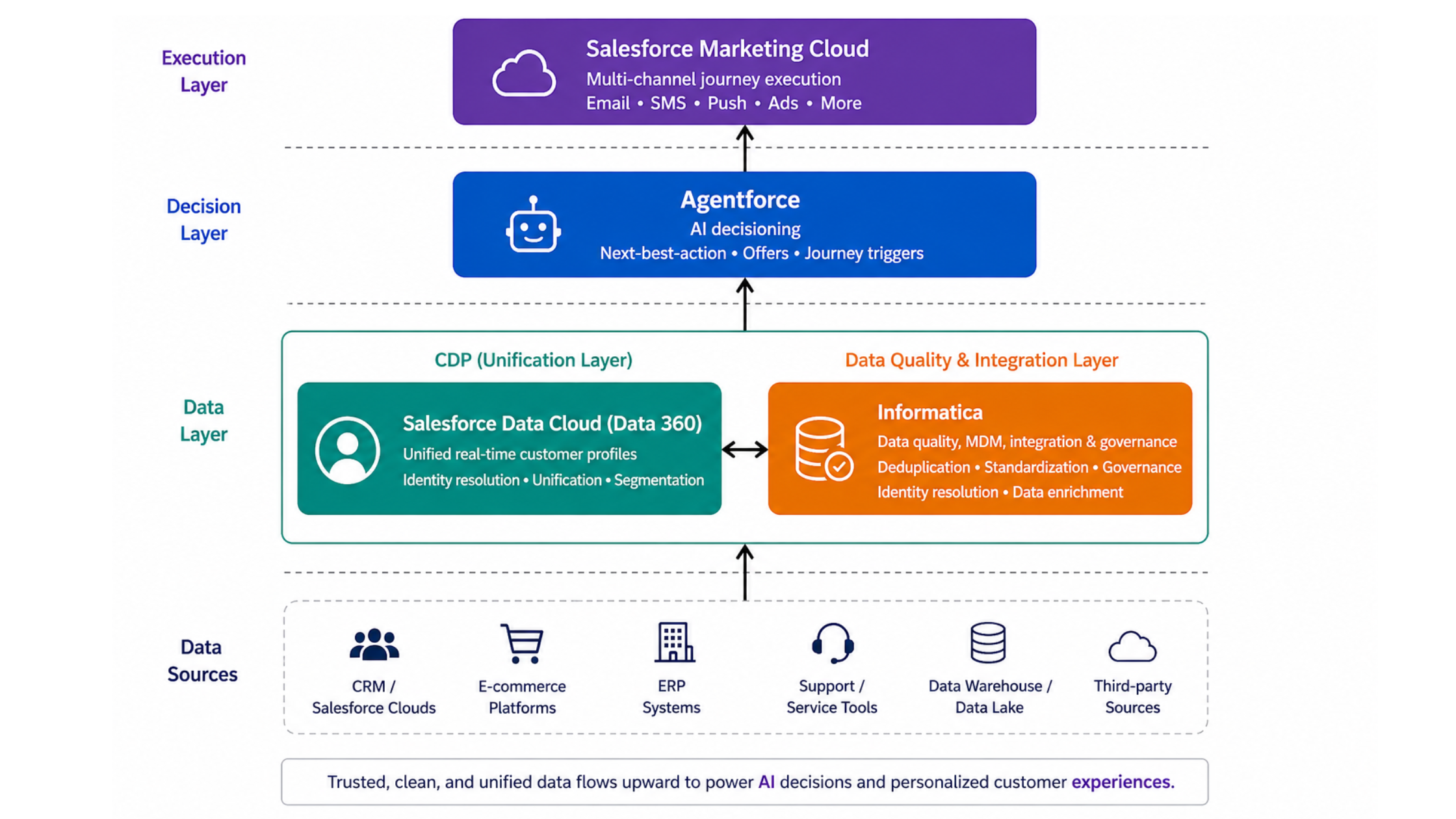
- The correct architecture is: data layer → decision layer → execution layer
- Skipping the data foundation creates long-term inefficiencies and poor personalization
Introduction
We've had the same conversation with marketing teams dozens of times: "We have Salesforce Marketing Cloud, so why isn't our AI actually doing anything useful yet?"
The answer is almost always the same: there's no Customer Data Platform (CDP) underneath it. Without one, AI decisions fire on incomplete context, journeys feel like guesses, and agents confidently recommend the wrong thing.
In the Salesforce ecosystem, Data Cloud (Data 360) is the CDP, and Informatica, now part of Salesforce, is the data quality and integration layer that ensures everything flowing into it is clean and trustworthy before any AI touches it. This article explains how they fit together and why the data layer has to come first.
What is a Customer Data Platform (CDP)?
A Customer Data Platform (CDP) unifies customer data from CRM systems, e-commerce platforms, ERP tools, support channels, and other sources into a single persistent customer profile. That profile becomes the trusted foundation for AI-driven personalization and decision-making.
In the Salesforce ecosystem, Salesforce Data Cloud (Data 360) acts as the unification layer. It connects customer data across Salesforce clouds and external systems, resolves identities in real time, and provides unified profiles for Agentforce and Marketing Cloud.
Informatica operates underneath this layer, helping standardize, deduplicate, and govern incoming data before it reaches Data 360. This ensures AI systems are working with trusted customer data instead of fragmented or conflicting records.
Without a strong data foundation, AI in Marketing Cloud operates on incomplete context, resulting in weak segmentation, inaccurate recommendations, and generic personalization.
The architecture that actually works
When designing a modern AI marketing stack on Salesforce, we place the CDP and data integration firmly in the data layer, not bolted on as an afterthought. The order of operations matters enormously. As a trusted Salesforce consulting partner for connected customer ecosystems, we've seen teams save months of rework by getting this sequence right from the start.
Salesforce Data 360: The CDP in Your Stack
Salesforce Data Cloud, now branded as Data 360, is the Customer Data Platform at the center of this architecture. Its job is to ingest data from across your Salesforce clouds, data warehouse, and external systems, resolve those records to individual customer identities, and maintain a single, continuously updated profile per person.
That unified profile is what Agentforce queries every time it makes a decision. When an agent determines what to offer a customer, which journey to trigger, or whether to suppress a message, it's reasoning against the Data 360 profile, not against Marketing Cloud's own limited view of the customer. Without this layer, agents operate on an incomplete context, and every decision downstream reflects that incompleteness.
Where Informatica fits, and why it matters now
Salesforce announced the $8 billion acquisition of Informatica in May 2025 and closed it ahead of schedule on November 18, 2025. The intent was clear from day one: bring Informatica's data catalog, MDM, integration pipelines, and governance capabilities directly into the Salesforce data stack to ensure enterprise data is not just unified, but also clean, trusted, and actionable.
Before data reaches Data Cloud, Informatica-powered data integration for CDP ecosystems helps deduplicate and standardize customer records coming from ERP systems, e-commerce platforms, and service tools, through MDM capabilities that ensure AI agents aren't making decisions on messy or conflicting records, but on a clean, governed version of truth.
As Marc Benioff put it at close:
"You have to get your data right to get your AI right. Without clean, connected, trusted data, there is no intelligence, only hallucination."
Agentforce and Marketing Cloud: the layers above
With the data layer established, Agentforce occupies the decision layer, reasoning over unified customer context to determine next-best-action, offers to surface, and journeys to trigger. The teams we've seen struggle with Agentforce almost always share the same root cause: the Data Cloud foundation wasn't in place first. Build the data layer first, and the decision layer gets dramatically better as a result.
Salesforce Marketing Cloud implementation for connected journeys sits at the top, the execution layer where journeys are built, emails and SMS are sent, and audiences are activated. In a well-designed architecture, it isn't trying to do the data work or the AI reasoning work. It's doing what it excels at: multi-channel journey execution at scale, with clean personalization data flowing in from below.
Use Cases: Why a CDP Matters for AI Marketing in Salesforce Marketing Cloud
Use Case 1: Retail Personalization Across Channels
A retail brand using Salesforce Marketing Cloud wants to personalize campaigns with Agentforce, but customer data is spread across ERP systems, e-commerce platforms, CRM, and support tools. Without a unified data layer, AI recommendations and journeys remain generic because Marketing Cloud only sees partial customer behavior.
With Salesforce Data 360, customer data is unified into a real-time profile, allowing Agentforce to trigger more relevant journeys based on browsing activity, purchase history, loyalty status, or abandoned carts.
Now with Informatica integrated into the Salesforce ecosystem, data is also standardized and deduplicated before entering Data 360, improving the accuracy and reliability of AI-driven personalization.
Use Case 2: Financial Services Customer Retention
A financial services company uses Salesforce Marketing Cloud for retention campaigns but struggles with inconsistent customer communication. Customers who recently upgraded products still receive basic onboarding emails because transactional systems and marketing systems are not synchronized.
By implementing Data 360 as the CDP layer, customer activity from banking systems, CRM, and service platforms is unified into a continuously updated customer profile. Agentforce can then identify high-value customers, suppress irrelevant campaigns, and trigger retention journeys at the right moment.
With Informatica helping govern and standardize customer records before they enter the CDP, duplicate identities and outdated records are minimized. This creates more accurate audience segmentation and improves trust in AI recommendations across Marketing Cloud campaigns.
Conclusion
The promise of AI in marketing is real, but only when the underlying CDP and data architecture are built correctly.
At Cymetrix, we’ve seen this consistently: Data Cloud, Informatica MDM, and Agentforce are powerful in isolation, but transformative when layered in the right sequence. Even as Salesforce evolves toward Marketing Cloud Next and more autonomous, AI-driven marketing, the foundation doesn’t change.
Skipping the data layer doesn’t save time; it creates debt that compounds at every layer above it.
If you’re ready to get your data layer right before scaling AI in Marketing Cloud, book a complimentary data architecture consultation with our team.
FAQs
1. What is the role of a CDP in Salesforce Marketing Cloud AI?
A CDP (Customer Data Platform) acts as the foundational data layer that unifies customer records from multiple sources: ERP, e-commerce, and support tools into a single profile. Without it, AI in Salesforce Marketing Cloud operates on fragmented data, leading to inaccurate personalization and poor campaign performance.
2. Why does AI in Salesforce Marketing Cloud fail without clean data?
AI models can only reason on the data they're given. When customer records are scattered across systems and inconsistent, the AI produces unreliable segmentation, wrong next-best-action recommendations, and personalization that feels generic. Clean, unified data from a CDP is what makes AI decisions trustworthy.
3. What does Salesforce Data Cloud do in an AI marketing architecture?
Salesforce Data Cloud (now Data 360) unifies customer data from Salesforce clouds, data warehouses, and external systems into coherent customer profiles. It acts as the grounding layer for Agentforce, so every AI decision is based on a complete, real-time view of the customer rather than siloed or stale data.
4. How does Informatica improve data quality for Salesforce Marketing Cloud?
Informatica's MDM and integration capabilities deduplicate, standardize, and govern customer records before they reach the Data Cloud. This means data from ERP systems, e-commerce platforms, and service tools is cleaned and reconciled at the source, so AI agents operate on a trusted, conflict-free version of customer truth rather than messy raw records.
5. What is Agentforce, and how does it connect to Marketing Cloud?
Agentforce is Salesforce's AI decision layer. It reasons over unified customer profiles from Data Cloud to determine next-best actions, surface relevant offers, and trigger appropriate journeys. Marketing Cloud then executes those decisions across channels: email, SMS, and more, making it the engagement layer that acts on Agentforce's intelligence.
6. What is the correct order to implement a Salesforce AI marketing stack?
The right sequence is: data layer first (Data Cloud + Informatica for unification and quality), then the decision layer (Agentforce), then the execution layer (Marketing Cloud). Skipping the data foundation and jumping to AI or journey-building creates technical debt that becomes increasingly difficult and expensive to fix.
7. What was the purpose of Salesforce acquiring Informatica?
Salesforce acquired Informatica to bring enterprise-grade data catalog, MDM, integration pipelines, and governance capabilities natively into its data stack. The goal was to ensure that data flowing into Data Cloud and powering Agentforce is not just unified, but also clean, deduplicated, and trustworthy.