

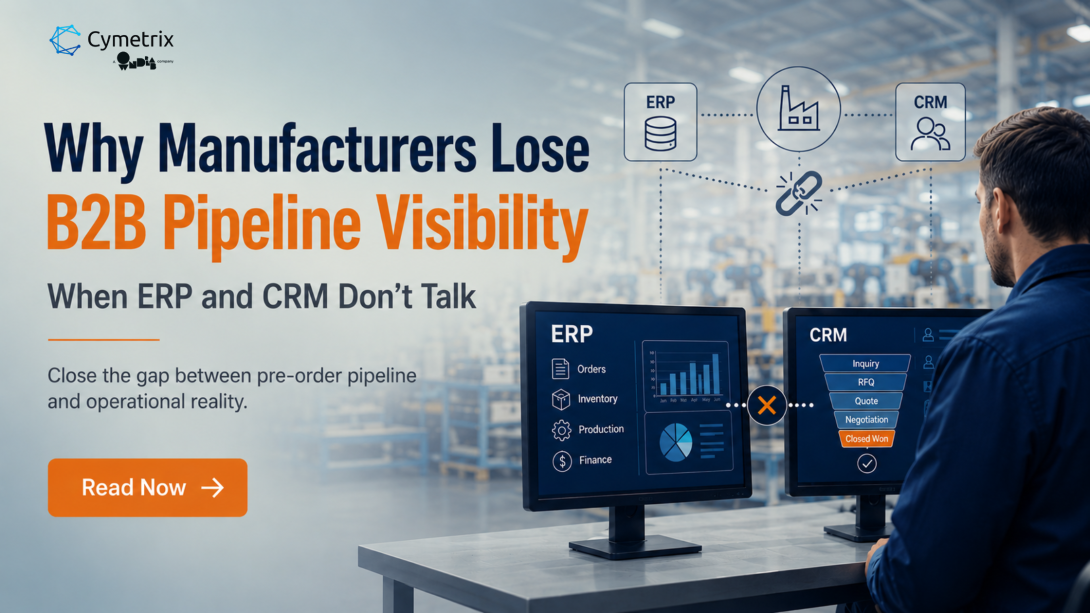
Most manufacturers rely on ERP as their operational backbone, while the pre-order pipeline sits in email threads and spreadsheets. Here's why that gap costs more than missed forecasts, and what it takes to fix it in 2026.
Key takeaways
- ERP tracks confirmed orders. It was never built to manage dealer inquiries, open RFQs or distributor opportunities.
- Most mid-market manufacturers run their pre-order pipeline through email and spreadsheets. ERP only enters the picture once a deal is done.
- Fewer than 50% of sales leaders trust their own forecasts and the problem gets worse without a CRM linked to operational data.
- The average manufacturing sales cycle runs 130 days. Every untracked deal is a forecasting risk.
- In 2026, connectivity alone is not enough. Manufacturers with integrated systems still miss forecasts when CRM data is structured for sales teams, not for operations.
- The real fix is two-part: connect the systems and then structure the pipeline data so it can actually drive demand planning decisions.
Ask the VP of Sales at a mid-market manufacturer how the manufacturing CRM pipeline is tracking this quarter and the honest answer is usually some version of: "We think it is around X, but we are not entirely sure."
That uncertainty is not a people problem. It is an architecture problem.
Most mid-market manufacturers rely on ERP as their primary system of record. SAP, Oracle, and Microsoft Dynamics all do their job well. Production runs on schedule. Inventory is tracked. Financials are clean. But ask those same systems about open dealer inquiries, outstanding RFQs or where a distributor opportunity stands and you get nothing. The pre-order pipeline, the entire phase from first contact to confirmed order, is invisible. That is because ERP was never designed to answer those questions. Without a connected CRM, most manufacturers are running their B2B pipeline on email threads, shared spreadsheets and sales reps' memories.
This article explains why the gap exists, what it costs and what it takes to fix it in 2026, including the harder problem that manufacturers with connected systems still face.
This is one of the most common issues we identify at Cymetrix. Cymetrix builds intelligent customer growth ecosystems - the connected layer of CRM, data, AI and marketing automation that drives revenue, pipeline and retention for mid-market enterprises. The ERP-CRM gap shows up across manufacturing clients of all sizes and it consistently causes forecast misses that leadership ends up attributing to other factors.
ERP was built for operations, not for the sales pipeline
ERP systems were built to manage what has already been decided: purchase orders, production schedules, inventory levels and financial reporting. They are exceptional at that. What they cannot do is track what is still being negotiated. Dealer buying intent, open RFQs, distributor pipeline status: these are pre-order activities. ERP has no fields for them because it was never meant to. The system only knows about an opportunity once it becomes a transaction.
When manufacturers try to use ERP as a sales tracking tool, they are asking it to do something it was not designed for. The result is a pipeline that only becomes visible at the moment it closes. By then, the selling is already done. The entire pre-order phase, from first inquiry to quote to negotiation and follow-up, has happened somewhere else, usually in someone's inbox.
For manufacturers who sell through dealer and distributor networks, this gap is even wider.
The dealer and distributor pipeline gap
Most mid-market manufacturers do not sell directly. They sell through dealers, distributors and channel partners. That indirect model creates a pipeline problem that ERP simply cannot solve. A dealer might be working on ten active opportunities at any given time: capital equipment inquiries, service contract discussions, repeat order conversations. The manufacturer has no visibility into any of it unless the dealer picks up the phone.
By the time an order lands in the manufacturer's ERP, the sale is already over. No stage, no probability, no early warning. Just a confirmed transaction or silence.
We have seen this pattern play out across industrial equipment, building materials and consumer goods manufacturers. Across those engagements, forecast misses tied to untracked dealer pipeline have ranged from 15% to over 30% of the quarterly number. Gartner reports that median forecast accuracy in B2B sales ranges between 70% and 79%, and that number drops further when channel partner pipeline data is absent.
For manufacturers generating a meaningful share of revenue through indirect channels, this is not just an inconvenience. It is a structural forecasting risk.
RFQ and quote-to-cash tracking without a CRM
The RFQ sits at the centre of the manufacturing sales cycle. A distributor requests a quote. The internal team prices it, gets approval and sends a response. The distributor may come back with changes, questions or go quiet. The deal either progresses to an order or it does not.
With a connected CRM, every step is logged: when the RFQ came in, when it was quoted, what follow-up happened, what the close probability looks like and when an order is expected. Sales leadership has a live view at any point. Without that infrastructure, the process is much less controlled. An inquiry arrives by email. A quote is built in a spreadsheet. The response goes back by email. Follow-up happens when someone remembers to do it. If a deal stalls, it quietly disappears with no record of what went wrong.
This matters a lot given that manufacturing sales cycles average around 130 days, one of the longest in B2B. Over that kind of timeline, tracking deals in email is not just inefficient; it is genuinely risky. Deals fall through the cracks. Quotes go unanswered. Competitors move faster.
For manufacturers considering CPQ tools to bring more discipline to this process, the starting point is a CRM that captures RFQ data in the first place. Without that foundation, CPQ has nothing to work with. (We cover this in more detail in our upcoming article: Salesforce CPQ for manufacturers: cut your quote-to-cash cycle, publishing July 21.)
When connected systems still miss forecasts
Here is something that often surprises manufacturers undertaking this journey. Connecting CRM and ERP does not automatically solve the forecasting problem.
We work with manufacturers who have Salesforce and SAP live, integrated and syncing in real time and who still run their quarterly planning meetings from a spreadsheet someone exported that morning. The issue is not connectivity. It is that CRM pipeline data is structured for sales management, not for operational planning.
A £50M pipeline in Salesforce does not tell the production team what to build. It does not say which products, in what quantities, by which delivery date or with what level of confidence. What operations actually need is a demand signal: 15,000 units of Product A, 4,000 units of Product B, required by November at 75% probability. That is actionable. A revenue number is not. Turning a pipeline figure into that kind of operational demand signal requires a translation step that most CRM deployments skip entirely.
There is also a trust problem. Visibility does not equal credibility. When stage probabilities are set by convention rather than by actual win rate data, a deal at 70% and a deal at 30% may close at the same rate in practice. Operations teams know this and they stop trusting the numbers. Many manufacturers with fully visible pipelines still hold monthly planning meetings where a human has to decide how much of the CRM data to actually believe.
Building a pipeline that operations can plan from requires two things: the right data structure, capturing the right fields at each stage and the right data discipline, with probabilities grounded in real win patterns, not gut feel. Both matter.
What pipeline invisibility actually costs manufacturers
The cost of running pipeline management without a CRM is not abstract. It shows up in real operational decisions, in staffing choices and in customer relationships. Here is what it typically looks like:
- Missed quarterly forecasts. When forecast inputs come only from confirmed orders, teams are essentially working backwards. The pipeline that should have informed the number was never captured.
- Reactive production planning. Without a view of what is likely to close in the next 30, 60 or 90 days, production teams cannot plan ahead. The result is last-minute capacity scrambles, overtime costs and delivery misses.
- Staffing decisions based on instinct. Without territory-level pipeline data, it is hard to know where to add sales resources and where to pull back. Some areas end up over-covered, others stretched thin.
- Lost deals with no learning. When deals live only in email and spreadsheets, there is no way to systematically understand why they were lost. The same mistakes happen quarter after quarter.
- Missed aftermarket revenue. Manufacturers who cannot see their post-sale installed base miss renewal, service and upgrade opportunities. We cover this further in Why manufacturers lose aftermarket revenue to poor post-sale data, publishing July 28.
Salesforce's State of Sales report found that only 35% of sales professionals fully trust their organisation's data. When a disconnected or missing CRM compounds that problem, manufacturers are forecasting without a foundation.
What does a connected ERP-CRM pipeline visibility look like
The goal here is not to replace ERP. It is to build the layer ERP was never meant to be and connect both systems so data moves between them in real time. In a connected setup, a dealer or distributor inquiry is captured in CRM as an opportunity. RFQs are logged against it with timestamps and revision history. Quotes are tracked and followed up within a defined workflow. When an order is confirmed, it flows into ERP for fulfilment and the CRM opportunity updates automatically. Leadership can see the full pipeline by dealer, region, product line and stage, not just what has already been booked.
For manufacturers operating at scale, this connection typically runs through a demand planning or Sales and Operations Planning (S&OP) process rather than a direct CRM-to-ERP data feed. The CRM supplies the opportunity signal. The S&OP layer, whether that is SAP Integrated Business Planning, Kinaxis or another platform, translates it into the production and procurement signals that operations can actually act on. Cymetrix's role is to make sure the CRM data going into that process is clean, structured and current, because demand planning tools are only as good as the pipeline data they receive.
In 2026, the most effective manufacturers are taking this further. AI-driven deal scoring replaces the arbitrary stage probabilities that make CRM forecasts hard to trust. Pattern-based models convert an early-stage pipeline into demand profiles with product-level and quantity-level estimates, before a formal RFQ has even been issued. This is where the integration layer becomes a platform for operational intelligence rather than just data movement. It is also where Cymetrix's AI-native approach delivers measurable value beyond a standard CRM implementation.
This all requires three things working together: a CRM managing the opportunity lifecycle, an ERP handling fulfilment and an integration layer keeping both in sync.
This is the type of work Cymetrix does for manufacturing clients. As a leading Salesforce consulting partner and MuleSoft consulting provider, Cymetrix combines 155+ certified consultants with deep ERP-CRM integration expertise to solve operational challenges, not just implement software. From connecting Salesforce with ERP systems to building AI-ready data pipelines, the focus is on creating a reliable flow of information that supports forecasting, planning, and execution.
It usually starts with a manufacturing pipeline audit: understanding where pipeline data currently lives, where it breaks down and what a connected architecture would look like for that client's specific ERP and channel setup. The gap is almost always bigger than leadership expected. The path forward is almost always clearer than they feared.
Conclusion
Manufacturers are not losing pipeline visibility because their teams are disorganised. They are losing it because ERP, the system most of them rely on, was built to record confirmed transactions. It was never meant to manage the process that creates them. Fixing this starts with connecting CRM and ERP. But in 2026, that is only the beginning. The manufacturers who consistently forecast well and plan production accurately are the ones who go further: structuring CRM data for demand planning, applying AI-driven scoring to make probabilities trustworthy and building the bridge between a sales pipeline number and an operational plan.
The payoff is real. A VP of Sales who can walk into a board meeting with a number they actually believe. A production team that plans ahead instead of firefighting. A sales force that knows exactly where to focus.
If you want to understand where your pipeline data is breaking down and what a connected architecture could look like for your business, a manufacturing pipeline audit is the right place to start. Get in touch with the Cymetrix team and we will walk you through what we typically find and what it takes to fix it.
Frequently asked questions
1. Why can't manufacturers just use ERP to track their sales pipeline?
ERP systems record what has already been decided: production orders, inventory, procurement, financials. A sales pipeline is made up of opportunities that have not yet become orders. ERP has no mechanism to capture dealer inquiries, open RFQs, quote status or follow-up activity. Using it as a pipeline tool means your forecast is built on booked revenue, not on opportunities that are still in play.
2. What is the ERP-CRM integration gap in manufacturing?
It is the disconnect between a manufacturer's operational system (ERP) and its sales management system (CRM). When the two do not communicate, order data sits in ERP while pipeline data, RFQs, dealer opportunities and quote history either sit in a disconnected CRM or do not exist at all. The result is a blind spot between first contact and confirmed order that makes accurate forecasting nearly impossible.
3. How do manufacturers track a B2B pipeline without a CRM?
Most rely on email threads, shared spreadsheets and individual sales reps' memories. This is manageable on a very small scale. As the number of dealers, distributors and open RFQs grows, it breaks down quickly. We have seen teams managing 30 or more active RFQs entirely in email, with no visibility for anyone above the rep level. Deals fall through, follow-ups are missed and there is no way to understand win and loss patterns when the data does not exist.
4. What causes pipeline forecasting failures in manufacturing companies?
The most common cause is incomplete input data. When the pipeline only becomes visible in ERP at the point of order confirmation, everything that happened before that moment is invisible to the forecast. Channel complexity makes it worse: manufacturers who sell through dealers and distributors have no direct view into partner pipelines. Even when CRM exists, unreliable stage probabilities undermine credibility. Gartner reports that fewer than 50% of sales leaders trust their own forecasts and that figure tends to be worse for manufacturers with indirect channel models.
5. How does connecting ERP and CRM improve manufacturing pipeline visibility?
A connected system gives manufacturers a pre-order pipeline (CRM) linked in real time to their operational systems (ERP). Dealer opportunities in CRM update automatically when corresponding orders are placed in ERP. Production teams can see what is likely to close in the next 60 days. For manufacturers at scale, this connection usually runs through a demand planning or S&OP layer that translates CRM opportunities into production and procurement signals. The integration layer, typically built on platforms like MuleSoft, keeps everything in sync without manual data transfers.
6. What is a manufacturing pipeline audit and do I need one?
A pipeline audit maps where your pipeline data currently lives, where it breaks down and what a connected architecture would look like for your specific ERP and channel setup. It covers how dealer and distributor opportunities are captured, how RFQs are tracked from inquiry to order, and what integration currently exists between your systems. If you sell through indirect channels, run long quote-to-cash cycles or regularly miss quarterly forecasts, a pipeline audit is a practical, low-commitment starting point before any technology investment.